
The Top 5 Secret Societies in History: The Truth Behind Historic Orders
Updated: 2 days ago
A lonely clerk in the Vatican Secret Archives pulls a misfiled parchment from a dusty ledger. His fingers tracing Latin script that hadn't seen the light since the Middle Ages. He notices a series of testimonies from a 1307 heresy trial. Detailing a bizarre ritual where young men were forced to kiss a cold, bearded face on a linen cloth. He realises right then that the line between official history and underground reality has always been paper-thin.
Grab a cup of coffee and let’s look at how these underground networks actually operated. For centuries, the real history of secret societies has been buried under mountains of sensational garbage and wild conspiracy theories. But when you strip away the modern folklore. The actual archival record is far stranger than the fiction. How do we separate the documented historical facts from the psychological operations and campfire stories that survive in paranormal circles today? Let's break down five historic orders where the true history and the esoteric mysteries collide.
While researching this case, you can explore our complete database over on our master Secret Societies Archive.
The Real Legacy Of Alamut Castle And The Nizari Ismaili Assassins
To understand how clandestine groups operate. We have to go back to the rugged peaks of the Alborz Mountains in late eleventh-century Persia. A brilliant, charismatic strategist named Hassan-i Sabbah seized the fortress of Alamut in 1090 without shedding a single drop of blood. He basically established an independent state using asymmetric warfare. Creating a highly disciplined cadre known as the Fedayeen. These men were trained to eliminate high-profile political targets in broad daylight, fully expecting to die in the process.
Marco Polo later spun wild yarns about a "Garden of Paradise" where young men were drugged with hashish. Surrounded by beautiful maidens, and convinced they had tasted heaven. But modern historians know this was largely a smear campaign by their enemies and a bit of Western Orientalist fantasy. The actual training was deeply intellectual and theological. Involving rigorous study of philosophy, mathematics, and espionage. They were deep-cover operatives, sometimes spending years embedded in a rival court before striking.
The Nizari Ismaili Order Structure
Grand Master (Da'i al-Du'at) - Operating from Alamut Castle
Senior Missionaries (Da'i Kabir) - Regional commanders & strategists
Ordinary Missionaries (Da'i) - Theological and political infiltrators
The Fedayeen (The Devoted) - High-precision deep-cover operatives
When the Mongols finally breached Alamut in 1256. They burned the legendary library to the ground. That single fire erased centuries of their own records. Leaving our understanding of their inner rituals at the mercy of hostile chroniclers. Honestly, it is like trying to reconstruct the inner workings of an intelligence agency using nothing but the propaganda of its wartime enemies.
Dig deeper into this with our Alamut Castle Breakdown.
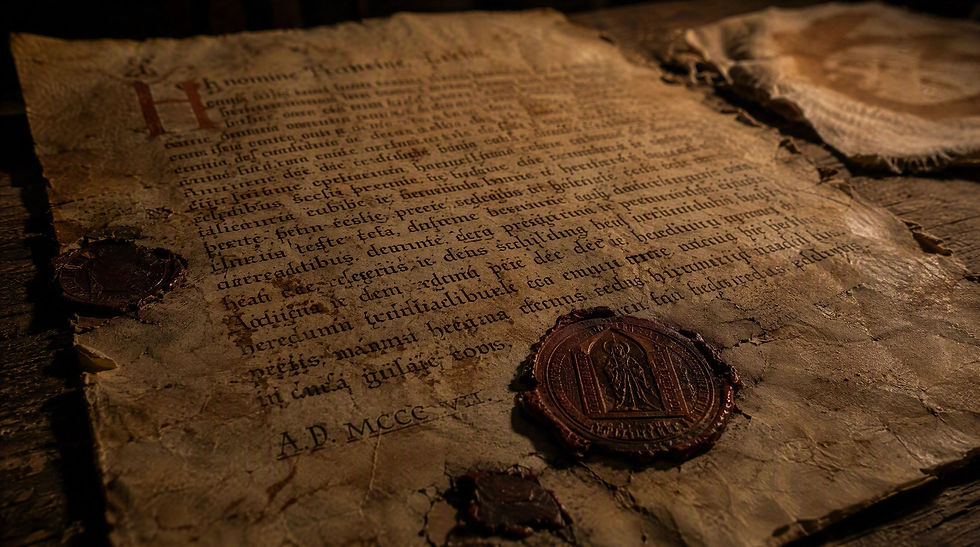
The Knights Templar Shroud Initiation And The 1307 Vatican Heresy Trials
Now let's talk about the big one that everyone in esoteric research circles brings up. On Friday the thirteenth of October, 1307. King Philip IV of France launched a coordinated, pre-dawn raid to arrest every Knight Templar in his kingdom. The official charges were absolute heresy. Including spitting on the cross, ritual sodomy, and worshipping a mysterious severed head named Baphomet.
But if you look at the actual trial documents preserved in the Vatican. A highly specific detail emerges regarding the neophyte initiation. Multiple independent testimonies describe an elite banking order secretly possessing a monochromatic, bearded image on a linen cloth. Which they integrated into their clandestine ceremonies. Modern researchers have mapped these trial records perfectly to the historical timeline of the Turin Shroud. After the Fourth Crusade ruthlessly sacked Constantinople in 1204. The Shroud vanished from public view for over a century. Only to reappear in the hands of the family of a prominent Templar, Geoffroi de Charny.
The Timeline of the Missing Shroud
1204: Sack of Constantinople - Shroud disappears from the imperial collection
1204-1307: The Clandestine Era - Templar elite utilize a folded image in secret trials
1307: The Downfall - Philip IV arrests French Templars; records mention a bearded image
1357: The Reappearance - Shroud displayed publicly in Lirey, France, by Charny's family
Skeptics argue these confessions were just the result of brutal torture on the rack. Which is true for a lot of the wilder accusations. But the consistency of the descriptions of this "bearded face" across different commanderies suggests they were looking at something real. The neophytes were reportedly made to venerate this cloth to test their absolute obedience to the secret hierarchy. It was a psychological breaking point. A classic counter-intelligence vetting mechanism disguised as a religious mystery.
To learn more take a look at our Knights Templar Shroud Initiation breakdown.
The Rosicrucian Enlightenment And The Mystery Of The Invisible College
Fast forward to the early seventeenth century in Germany. Where the printing presses suddenly began spitting out a series of anonymous manifestos. The Fama Fraternitatis and the Confessio Fraternitatis announced the existence of a highly secret society of Christian mystics and alchemists. They claimed to possess ancient, forgotten knowledge that could trigger a total reformation of human understanding. They spoke of their founder, Christian Rosenkreuz. Whose perfectly preserved body was supposedly discovered in a hidden, high-tech tomb.
The European intellectual community went absolutely nuts trying to find these guys. Rene Descartes famously spent months trying to contact the order. But he came up completely empty-handed. This led many historians to conclude that the Rosicrucians were essentially an early modern prank. A brilliant piece of esoteric satire cooked up by a Lutheran theologian named Johann Valentin Andreae.
But even if the order didn't exist as a formal organisation initially. The manifestos created a massive psychological reality. Intellectuals began acting as if they were part of this global network. Giving birth to the "Invisible College." This underground exchange of scientific and alchemical data eventually coalesced into the Royal Society of London. The myth literally manifested the reality, changing the course of Western science forever.
To research this further, take a look at our Rosicrucian Enlightenment breakdown.
The Bavarian Illuminati Inside Ingolstadt And The 1785 Crackdown
No historic order has been more misunderstood, commercialised, and distorted than the Bavarian Illuminati. On May 1, 1776. A law professor named Adam Weishaupt founded a secret society in Ingolstadt with just five original members. Weishaupt was deeply frustrated by the suffocating grip of the Catholic Church on academia and government. So he decided to fight back using the enemy's own weapons.
His strategy was pure infiltration. He joined the Freemasons and began systematically recruiting their wealthiest, most influential members into his own higher degrees. The Illuminati weren't worshipping demons or trying to summon ancient entities. They were radical Enlightenment rationalists who wanted to overthrow monarchies and establish a secular meritocracy. They used code names like Spartacus and Cato. Creating an incredibly rigid, compartmentalised cell structure where lower-tier members had absolutely no idea who was running the show.
The whole thing came crashing down in 1785 when a courier named Jacob Lanz was struck and killed by lightning while carrying secret documents. The Bavarian government seized the papers. Launched a massive crackdown. And published the order's internal correspondence for the entire world to see. But the panic had already gone global. The sudden exposure of a real, working political conspiracy created a permanent blueprint for every deep-state paranoia story that followed.
To learn more about this historic case, take a look at our Bavarian Illuminati breakdown.
The Hermetic Order Of The Golden Dawn And Modern Ritual Magic
To close this out, let's step into the late nineteenth century, where the industrial revolution met a massive resurgence of the occult. In 1887, three Freemasons discovered a set of cipher manuscripts in a London bookstore that allegedly contained the initiation rituals of an ancient German order. They used these papers to found the Hermetic Order of the Golden Dawn. Creating a highly structured system that synthesised Tarot, alchemy, astrology, and Kabbalah into a single framework.
Unlike the Illuminati. These guys weren't trying to overthrow governments. They were obsessed with mapping the human psyche through ritual theatre and altered states of consciousness. The membership list read like a who's who of cultural elites. Including W.B. Yeats, Bram Stoker, and eventually, the infamous Aleister Crowley.
The order eventually self-destructed in a spectacular fashion around 1900. Ruined by massive ego clashes, lawsuits, and Crowley’s chaotic antics. Skeptics later proved that those original cipher manuscripts were almost certainly a deliberate forgery cooked up to give the order instant historical legitimacy. But the psychological impact of their ritual framework was undeniable. They created the exact vocabulary and structural models that almost every modern Western esoteric group still uses to this day.
For more information take a look at our Hermetic Order Of The Golden Dawn breakdown.
Top 5 Historic Orders Frequently Asked Questions
Did the Bavarian Illuminati survive the 1785 government crackdown?
No reliable historical evidence supports the survival of the Bavarian Illuminati after the 1785 ban. The Bavarian government published the order's seized correspondence, which completely exposed and dismantled their compartmentalised cell structure.
What was the connection between the Knights Templar and the Turin Shroud?
Vatican trial records from 1307 contain testimonies describing a secret initiation ritual involving a bearded face on a linen cloth. Historians note this timeline matches the disappearance of the Turin Shroud from Constantinople before its public reemergence in France.
Who founded the historic orders known as the Assassins?
The Nizari Ismaili state and its formidable operative force were founded by Hassan-i Sabbah in 1090 after he captured Alamut Castle. The stories of drug-induced compliance were largely myths created by contemporary adversaries and Western travelers.
Were the original Rosicrucians a real organization?
Modern historical consensus suggests the initial 17th-century Rosicrucian manifestos were an esoteric satire written by Lutheran theologians. However, the publications inspired intellectuals to form real networks, which eventually led to the creation of the Royal Society.
What were the cipher manuscripts of the Golden Dawn?
The cipher manuscripts were a set of documents discovered in London in 1887 that outlined occult initiation rituals. While they were claimed to be ancient, historical analysis indicates they were likely a clever nineteenth-century fabrication to establish instant lineage.
How did historic orders infiltrate traditional Freemasonry?
Groups like the Bavarian Illuminati utilised Freemasonic lodges as vetting grounds. Because Freemasonry offered a private network of influential citizens, leaders of covert orders would join and quietly recruit candidates into their own higher degrees.
Sources and Further Reading
Barber, Malcolm. (2007). The Trial of the Templars. Cambridge University Press.
Daftary, Farhad. (1995). The Assassin Legends: Myths of the Isma'ilis. I.B. Tauris.
van Dülmen, Richard. (1975). Der Geheimbund der Illuminaten. Frommann-Holzboog.
Yates, Frances A. (1972). The Rosicrucian Enlightenment. Routledge & Kegan Paul.
Gilbert, R. A. (1997). The Golden Dawn Scrapbook: The Rise and Fall of a Magical Order. Samuel Weiser Inc.


Comments