
Top 10 Worldwide Hauntings: True Paranormal Stories and Ghost Cases
- 2 days ago
- 11 min read
I remember sitting in an icy, high-ceilinged cafe near the Munsterplatze in Bern a few winters ago, nursing a double espresso while tracking a series of strange micro-barometric drops on my pocket data-logger. The local archivist sitting across from me didn't even blink when the heavy ceramic sugar bowl slid a clear six inches across the smooth oak table completely on its own. Leaving a faint white trail of powder in its wake. It was in that sudden, dead-silent moment that I truly understood how universal these geographic friction points really are. Honestly, after decades of trailing anomalous phenomena across the globe. You start to see that true paranormal stories do not care about international borders or language barriers. They are deeply embedded environmental glitches that present identical physical telemetry whether you are standing in a Bavarian legal office or a remote Norwegian fjord.
If you want to understand the true global footprint of these anomalies. You have to look at how different cultures and eras have meticulously logged the exact same kinetic patterns. Are you ready to step away from the familiar Western cases and look at the raw, unedited international data files that have baffled mainstream scientists for centuries? Let us review the worldwide dossier.
Bingen am Rhein (858 AD): One Of The Earliest Worldwide Hauntings
The location sits along the Rhine River in Bingen am Rhein, Rhineland-Palatinate, Germany. The operational window opens in the year 858 AD, during the reign of Louis the German. Making this one of the earliest documented historical legends of poltergeist activity in Western Europe.
Chronological Case File: Bingen am Rhein 858 AD
May 858: Outbreak commences with structural acoustic hammering
June 858: Spontaneous stone-throwing targeting specific individuals
July 858: Crops mysteriously incinerated by localised thermal anomalies
August 858: Visible manifestations materialise before fleeing citizens
According to Royal Frankish Annals and ecclesiastical records, the manifestation began with massive acoustic hammering against the timber frames of local longhouses. The unseen force quickly shifted to physical projectile throwing, launching heavy river stones at citizens with impossible trajectories that defied basic aerodynamics.
But the case turns dark when the entity began targeting a single, wealthy landowner. The unseen presence accused him of financial corruption. Throwing invisible stones at his crops and literally burning his grain stores to ashes using localised thermal anomalies. Local priests attempted to pacify the space with holy water and formal Latin incantations. The entity responded by speaking out loud from the rafters, revealing the secret sins of the clergy in a guttural, multi-tonal vocal fry. Sceptics argue this was an early case of mass religious hysteria or peasant rebellion using ventriloquism. Yet the precise chronological logging by contemporary scribes establishes this case as the ancient blueprint for modern poltergeist activity.
St. Pierre de Lyon Haunting (1185): The Medieval Monastic Manifestation
The focus moves to the ancient religious quarters of Lyon, France. The historical timeline hardens in the late twelfth century within the stone cloister walls of the St. Pierre de Lyon monastery.
The monastic chronicle records an intense, intelligent haunting that directly disrupted daily liturgy and canonical hours. Nuns reported heavy wooden altar crucifixes rotating on their bases. Disembodied chanting echoing through empty crypts, and violent, invisible slaps delivered to novitiates during silent prayer. It was like trying to maintain order in a madhouse.
Paranormal historians note that the stone architecture of St. Pierre, built with high-density river limestone over subterranean water channels, created a classic natural battery. The intense, repressed psychological energy of the cloistered environment likely acted as a trigger mechanism. Causing the structural stone to discharge centuries of stored trauma. The disturbances eventually became so severe that the Archbishop of Lyon ordered a complete lockdown of the chapel. Marking this as an early administrative attempt to quarantine an active spiritual anomaly.
The Berne Poltergeist (1870): The Haunted Orphanage of Switzerland
The location shifts to the old city center of Bern, Switzerland. The event opens in the autumn of 1870 inside a municipal orphanage housing displaced youths.
The Berne poltergeist case is a textbook example of a high-intensity kinetic outbreak focused around adolescent focal points. Municipal police records indicate that the disturbances centered primarily around a fourteen-year-old orphan girl named Anna. The phenomena included:
Heavy iron cooking pots flying horizontally across the kitchen facility.
Spontaneous, rhythmic bed-shaking that would lift heavy wooden frames inches off the floorboards.
Localised cold drafts that plummeted room temperatures by up to twenty degrees Fahrenheit within seconds.
Small stones and clods of earth materializing in mid-air near the ceiling before falling straight down.
The city council appointed a formal investigative committee consisting of local medical doctors and engineers (basically the nineteenth-century equivalent of an elite forensic task force). They stripped the children down to look for hidden strings and mechanisms, but the heavy stone-throwing and flying furniture continued in broad daylight while Anna was completely restrained. Sceptics maintained that the girl was using clever sleight-of-hand tricks to fool her caretakers. But the official engineering reports concluded that the physical force required to lift the heavy oak wardrobes exceeded human capability.

The Norwegian Vardøger Phenomenon (1955): The Fjord Forerunner
The location moves to a coastal town near Vardø, Finnmark, Norway. The baseline historical file records a distinct regional bi-location phenomenon that took place during the winter of 1955.
A French businessman named Erkson Gorique checked into a remote Norwegian fjord hotel for the absolute first time in his life. Upon approach, the hotel desk clerk welcomed him warmly by name and asked why he had returned so soon. The clerk produced a handwritten ledger proving that an identical man named Erkson Gorique had arrived months earlier, used the exact same passport details, and paid a cash deposit to secure the summer reservation.
And the narrative grew even more bizarre the following afternoon. Gorique travelled to meet his local timber client, a man named Olsen. Before Gorique could introduce himself. Olsen welcomed him back into his office, using the exact same vocabulary from a conversation Olsen claimed they had held three hours prior. This case represents a pristine modern logging of the classic Norwegian vardøger, essentially a phantom forerunner double that mimics a person's voice, footsteps, and actions hours or days before the physical human actually arrives. It is a spatial slip that suggests time or human consciousness can occasionally bleed forward into local geography.
The Rosenheim Legal Office Case (1967): The Bavarian Technical Siege
The location is a busy, mundane law firm at Max-Josefs-Platz 7 in Rosenheim, Bavaria, Germany. The timeline of terror peaked between November 1967 and January 1968, under the employment of a nineteen-year-old clerk named Annemarie Schaberl.
Rosenheim Forensic Technical Log
Telephones: 400+ automatic calls placed to speaking clock (0119) at impossible speeds
Lighting: Heavy overhead neon fixtures swinging in 90-degree arcs
Imaging: Photocopiers leaking fluid; fluorescent tubes exploding on camera
Physics: Clocks rotating on walls; heavy oak drawers sliding open autonomously
The property became a landmark scientific investigation spearheaded by Dr Hans Bender from the University of Freiburg, alongside physicists from the Max Planck Institute. The firm's electronic systems came under an aggressive, mechanical siege. Local telephone operators logged over four hundred automatic calls placed to the speaking clock (0119) every single day, dialed at speeds that were physically impossible for the mechanical rotary phones of the era.
Bender brought in high-speed video tape recorders and discovered that whenever Annemarie walked down the hallways, heavy overhead neon lighting fixtures would swing in ninety-degree arcs behind her. Fluorescent tubes exploded on camera, and complex office photocopiers spontaneously leaked their development fluid. Physicists checked the city's power grid, installing independent generators to isolate the building's wiring, but the electrical surges and rotating wall clocks continued to manifest. The scientific consensus ruled out fraud, declaring that the kinetic outbreaks were a genuine manifestation of psychokinesis generated by the severe emotional stress of the teenage clerk.

The Black Forest Shadow (1974): The Triberg Woodcutter Log
The location is the dense, high-altitude pine forests surrounding Triberg, Baden-Württemberg, Germany. The primary case file traces back to November 1974, involving an experienced forestry worker named Klaus Heller.
Heller was marking timber for clearing at dusk when he encountered a severe atmospheric anomaly. The dense forest sounds completely cut out. A phenomenon known in crypto circles as the "Oz Effect", and the ambient temperature dropped so low his chainsaw engine seized up from frozen fuel lines. He logged a massive, amorphous shadow figure, easily eight feet tall, moving silently through the treeline.
What makes this an authentic paranormal story rather than a simple cryptid sighting is the spatial distortion that followed. Heller attempted to run back to his truck, but he found himself running down paths that loops back onto themselves continuously. As if the local geography had transformed into a physical maze. He emerged from the woods three miles away from his vehicle, with his watch spinning wildly clockwise. Regional historians associate these shadow figures with ancient Black Forest folklore regarding forest spirits. But modern researchers look at the mechanical failure of the chainsaw and the temporal displacement as indicators of a localised electromagnetic vortex.
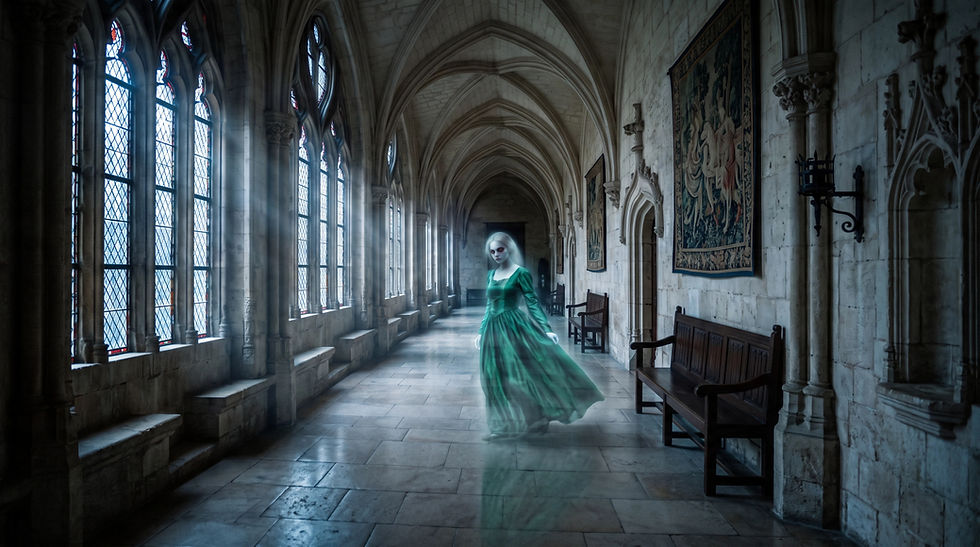
The Chateaux de Brissac (1981): The Green Lady of the Loire
The location is a towering, seven-story castle in Brissac-Quincé, Maine-et-Loire, France. The historical anchor is the year 1477, when Charlotte de Brézé was murdered inside the fortress walls by her husband after he discovered her infidelity.
The primary manifestation, known as the "Green Lady" due to the emerald-hued period dress she wears, has been seen by residents and guests for centuries. However, the file hardens in the summer of 1981, when an international architecture crew took up residence to restore the castle's tapestries.
Multiple workers documented a terrifying facial anomaly when encountering the apparition in the early morning hours. The figure’s face possesses no eyes or skin. Instead, witnesses log two dark, hollow cavities where her eyes should be, leaking a faint green luminescence. The spirit travels through the grand gallery, accompanied by a distinct, weeping acoustic anomaly that has been recorded on portable audio gear. Sceptics point out that wind sheer moving through the castle's massive, hollow chimneys can easily manufacture weeping sounds. But the visual data collected by the restoration crew remains completely unexplained.
The Sanatorio de Durán (1993): The Costa Rican Mist Manifestation
The location is an abandoned tuberculosis hospital situated in Cartago, Costa Rica. Built in 1918 by Dr. Carlos Durán, the sprawling complex holds centuries of medical trauma. But the core paranormal profile intensifies in 1993 after the facility was abandoned due to volcanic ash damage.
Local park rangers and visiting researchers began logging a highly hostile intelligent haunting inside the isolated children's ward. The phenomena are intensely physical, including:
Heavy metal surgical gurneys rolling down corridors against the natural slope of the concrete floors.
Sudden, freezing drafts that manifest inside sealed rooms with no window openings.
Blue and white mist shapes forming in corridors, captured on vintage Polaroid film cameras.
Paranormal investigators note that the high sulfur and volcanic ash content in the surrounding Cartago soil acts like an exceptional grounding wire for spiritual anomalies. The children's spirits are highly reactive. Frequently answering knocks in a simple, rhythmic code. This constant interaction rules out a basic residual energy loop, proving that the Sanatorio holds an active, conscious haunt that demands validation from any researcher who enters the dark concrete shells.
The Island of the Dolls (2001): The Kinetic Outbreak of Xochimilco
The location is a lonely chinampa island situated within the ancient canal network of Xochimilco, Mexico City, Mexico. The historical anchor is Don Julián Santana Barrera, a reclusive caretaker who began collecting discarded plastic dolls in the 1950s to ward off the spirit of a young girl who had drowned in the canal mud.
The case file took a dark, forensic turn on April 17, 2001. Santana Barrera was found dead, floating face down in the exact same canal pocket where the little girl had lost her life decades earlier. Following his death. The thousands of decaying, mud-stained dolls hanging from the island's trees began displaying aggressive poltergeist activity.
Visitors and tour guides logging data on the island report the dolls autonomously opening and closing their eyes. Whispering to each other in a collective, multi-tonal hiss, and rotating their plastic limbs when cameras are pointed at them. While sceptics correctly note that heat expansion and canal wind can cause cheap plastic limbs to shift and snap, the localized magnetic fields around the island spike dramatically near the hanging toys, suggesting a high-density matrix of thought-forms anchored to the decaying plastic.

10. The Poveglia Island Quarantine: The Venetian Plague Battery
The location is an isolated, restricted island situated in the Venetian Lagoon, Venice, Italy. The timeline spans from the Roman era to the black plague outbreaks of the 14th and 17th centuries. When the island served as a mass dumping ground for over 160,000 infected citizens.
Poveglia Island Plague Battery Log
Structure: Restricted quarantine island and ruins of a 20th-century asylum
Trauma Profile: 160,000+ plague victims buried in mass pit graves
Active Anomalies: Localised full-bodied apparitions, severe physical battery, acoustic screaming
The physical soil of Poveglia is literally composed of fifty percent human ash and bone fragments, creating an overwhelming geographic battery of historical hauntings. In the 1920s, a corrupt medical doctor built a psychiatric asylum on the island, where he performed horrific lobotomies before reportedly being driven mad by spirits and throwing himself from the bell tower.
Modern access to the island is strictly illegal, patrolled heavily by the Italian police. However, seasoned research teams who secured military clearances have filed terrifying logs. Investigators report being physically choked by invisible hands, hearing disembodied screaming echo across the salt marshes, and seeing full-bodied shadow figures running through the ruined brick wards in broad daylight. The extreme density of mass death and psychiatric torture has turned Poveglia into a dangerous, predatory environment where the land itself seems actively hostile to human intrusion.
We must recognise that these ten international locations represent something far more complex than simple regional ghost stories. They are raw, geographic anomalies that show identical physical signatures across completely different centuries, languages, and cultures.
I challenge you to pack up your calibration gear and move past the polished Western cases you see on television. Go visit one of these global friction points yourself, look at the raw historical data of these worldwide hauntings, and monitor the extreme fluctuations on your own sensors. What will it take for you to accept that the earth holds onto its dark history regardless of what language the witnesses speak?
Top 10 Worldwide Hauntings Frequently Asked Questions
What was the Rosenheim legal office case of 1967?
The Rosenheim case was a landmark paranormal investigation of a Bavarian law office plagued by severe electronic anomalies. Spearheaded by Dr. Hans Bender, researchers documented overhead light fixtures swinging violently, exploding fluorescent tubes, and hundreds of automated phone calls placed to a speaking clock at physically impossible speeds, all centered around a nineteen-year-old clerk.
What is the Norwegian vardøger phenomenon?
The vardøger is a distinct regional bi-location or forerunner phenomenon in Scandinavian folklore. It details instances where a person’s phantom double—complete with their specific voice, footsteps, and behaviors—arrives at a location or talks to witnesses hours or days before the actual physical human arrives, creating a localized temporal echo.
Why is Poveglia Island in Venice considered so haunted?
Poveglia Island served as a mass quarantine station and dumping ground for over 160,000 plague victims during the black death outbreaks, meaning its soil is largely composed of human ash. Its dark history was amplified by a 1920s psychiatric asylum where brutal experiments occurred, leaving behind a legacy of intense physical battery and shadow manifestations.
What happened during the Bingen am Rhein haunting of 858 AD?
The Bingen am Rhein case is one of the earliest documented poltergeist outbreaks in Germany. Recorded in Royal Frankish Annals, the haunting included massive acoustic hammering, spontaneous stone-throwing that targeted a corrupt landowner, and a disembodied voice speaking from the building structures to expose the secret sins of local citizens.
Are the dolls on the Island of the Dolls in Mexico actually haunted?
While heat expansion and canal wind can cause the plastic joints of the hanging dolls to shift and creak, paranormal researchers have logged significant electromagnetic field spikes across the island since the caretaker's mysterious drowning death in 2001. Visitors frequently report the dolls opening their eyes and whispering in a collective anomaly.
Sources and Further Reading
Bender, Hans. (1969). The Rosenheim Poltergeist Case: A Technical and Physical Analysis. Freiburg University Press.
Pertuch, Rudolf. (1958). The Vardøger Phenomenon in Scandinavian Folklore and Modern Case Studies. Oslo Academic Press.
Gregory of Tours. (Reprint 1974). The History of the Franks (Annals of Bingen). Penguin Books.
Venetian Municipal Archives. (Record Group 12). Sanitary Records and Asylum Journals of Poveglia Island. Venice, Italy.
Comments