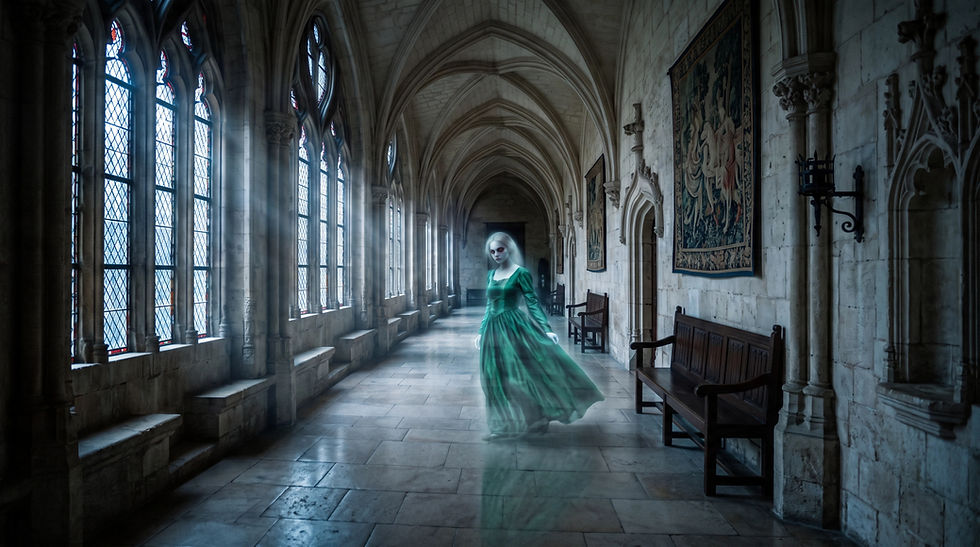
The Berne Poltergeist of 1506: The Murdered Prior and the Angel Scam
A terrified monk stood pinned against the cold stone wall of his monastery cell. His eyes wide with alarm as heavy woollen bedclothes were violently wrenched off his mattress by completely invisible hands. The midnight intrusion was immediately followed by a bizarre, scratching noise that vibrated from deep within the solid masonry layout. Sounding exactly as if an unknown, subterranean creature were desperately clawing its way through the walls. Within days, these localised bedroom anomalies would systematically expand. Invading every single room of the holy sanctuary and throwing the entire monastic community into total chaos.
The shocking, physical manifestations marked the opening of the Berne poltergeist of 1506. An extraordinary historical haunting that stands as one of the most complex, politically charged examples of a communicative spirit outbreak in Renaissance Europe. But what exactly was driving these persistent acoustic disruptions and violent kinetic attacks inside a cloistered religious house? Could a modern forensic audit separate the raw parapsychological baseline of this Swiss chronicle from a calculated, high-stakes theological conspiracy that ended in public executions?
While researching this case, you can explore our complete database of phenomena over on our master Ghosts and Hauntings Archive.
Swiss Historical Framework: The Jetzer Affair and the Maculate Controversy
To fully understand the political gravity of the Berne poltergeist of 1506. The timeline must be analysed within the broader context of the Jetzer Affair. A massive religious scandal that brought Switzerland to the brink of civil unrest. The phenomena manifested during a bitter intellectual conflict known as the Maculate vs. Immaculate Conception controversy.
While the rival Franciscan order successfully popularised the view that the Virgin Mary was born free of original sin. The Dominican Order in Berne faced severe loss of public prestige and financial offerings for defending the traditional "Maculate" stance. For researchers tracking haunted places in Europe. The resulting anomalies serve as a textbook example of a theological hoax engineered to weaponise a suspected poltergeist outbreak for political supremacy.
1506 — The Scrabbling in the Dominican Walls
To truly understand this historical haunting, we honestly have to look back to the early opening months of 1506. The bizarre visitations unfolded within the cold brick and stone of the Dominican monastery in Berne, Switzerland. The primary focus of the energy was a young, impressionable novice monk named Jetzer. Who approached his monastic prior with a highly disturbing, firsthand story.
Jetzer claimed that his bedclothes were being aggressively hauled off his body by an unseen entity nearly every single night. He was also deeply bothered by a sequence of disembodied animal sounds that echoed around his cell.
The prior’s initial, private reaction to the novice’s wild tale is not preserved in the local archives. But within a matter of days, the structural disruptions became completely impossible to ignore. The soft, animal scratching noises rapidly evolved into heavy, rhythmic knocking sounds.
No longer confined to Jetzer's private quarters. The thumping noises actively invaded the entire monastery. No room was free of the acoustic attacks, which manifested dynamically at any time of day or night. Despite the most careful internal investigation executed by senior brothers, absolutely no natural or mechanical explanation could be found.
The Relic Escalation and the Heinrich Kalpurg Confession
Sensing a severe spiritual threat. The prior decided to place a sequence of sacred holy relics directly into Jetzer's cell. Firmly hoping they would cure the environmental problem. Essentially, the religious intervention made the situation worse. The knocking noises instantly grew much louder, and heavy oak doors began to be flung wide open and slammed shut with immense physical violence.
Massive stones were lobbed about through empty hallways by completely invisible hands, and common household objects floated up from tables. Drifting smoothly across the rooms before dropping flat onto the floorboards.
A disembodied voice then began to mutter unintelligibly out of the empty air. After a few days of chaotic vocalisations. The entity managed to make its phrases clearly understood.
The voice announced to the gathered community that it was the unquiet, earthbound spirit of Heinrich Kalpurg. An individual who had served as the monastery's prior back in the 1340s.
The current prior immediately consulted the ancient, dust-covered monastic records and discovered a stunning piece of verification. There had indeed been a prior of that exact name at that date.
The archives confirmed Kalpurg had been ceremoniously expelled from the order for unspecified acts of severe inefficiency and incompetence.
The spirit then announced through the dark that he had been a grievous sinner in life. A statement the listening monks interpreted as a direct confession that he had been guilty of embezzling large amounts of monastic funds. Or perhaps something even worse. According to the disembodied voice, Kalpurg had fled the country to Paris. Where he had eventually been murdered in sordid, tragic circumstances.
The Immaculate Conception Debate and Saintly Apparitions
The prior immediately ordered continuous, solemn masses to be said inside the monastery church. Beseeching God to bring eternal peace to the unquiet soul of Kalpurg so that the building might return to normal. The religious strategy appeared to work. The physical disturbances began to tail off, and the exhausted monks hoped their ordeal was finally over.
But then, things took a truly bizarre, calculating turn. The prior decided that Jetzer's new-found ability to communicate directly with the dead would enable the order to settle some massive, unresolved theological matters. In particular, he wanted to know if the Virgin Mary had been conceived completely free of original sin.
The theological matter might seem somewhat obscure to a modern researcher. But in the early 16th century. It was a matter of fierce, spirited debate between the Franciscans (who insisted she had been conceived free of sin) and the Dominicans (who adamantly insisted she had not).
The next time the disembodied voice spoke out inside Jetzer's cell, the novice asked the prior's question. The entity sounded completely nonplussed by the deep theological query. The voice stated flatly that it did not know the answer, but it would go and ask St Barbara. A popular saint whom Kalpurg seemed to know quite well in the afterlife.
A week later. A figure claiming to be St Barbara materialised directly inside Jetzer's cell, clad in brilliant, shining white robes. Jetzer asked the question again, and the saintly apparition assured him she would find out. After another week had passed. She returned to the cell, this time accompanied by two glowing angels. She announced to the novice that the Dominicans were completely right in thinking that the Virgin Mary had not been conceived free of original sin.
The Fabricated Stigmata: Chemical Fraud in the Cell
As the "saintly apparitions" escalated, the conspiracy shifted from simple voice play to brutal physical body alteration. To solidify the global authority of their new prophet. The senior friars began drugging Jetzer’s evening wine with narcotics. Once the novice was incapacitated. The monks utilised sharp needles, corrosive chemical agents, and heated iron rods to forcibly inflict the Stigmata, the physical wounds of Christ, onto Jetzer’s hands, feet, and side. When Jetzer awoke, the bleeding wounds were presented to the public as divine proof of his spiritual mediumship. Attracting massive crowds of wealthy patrons to the monastery.
The Bishop’s Trap and the Unmasking of the Angels
Jetzer delivered the answer to the delighted prior, and the fame of the monastery and its spectacular visitation spread far and wide across Switzerland. But the local bishop remained entirely unconvinced by the convenient divine endorsement.
He sent Jetzer a series of complicated, highly structured theological questions that he should ask the saint during her next scheduled appearance. Aiming to make absolutely sure she was not an evil spirit in disguise.
The saint duly reappeared inside the cell, accompanied by her two silent angels. As Jetzer began to ask the bishop's complex questions, he started to sense that something was physically wrong with the entities.
Acting on pure instinct. The novice made a desperate lunge forward into the darkness and grabbed the saint. The heavenly figure fought back with remarkably unsaintly, physical vigour.
In the rough-and-tumble scuffle that followed. Jetzer ripped away a disguise and unmasked one of the "angels" as his own prior. While the "saint" and the other angel turned out to be senior monks from the monastery.
The cornered prior quickly assured the shocked novice that they had only arranged the elaborate theatrical stunt to test his credibility. He loudly declared that Jetzer had passed the test.
Jetzer seemed to accept the prior's frantic cover story. Indeed, he appeared to be eagerly awaiting his next saintly visit. Which transpired a few nights later when figures claiming to be St Bernard of Clairvaux and St Catherine of Siena walked into his cell.
The Fifteen-Foot Drop and the Bishop's Verdict
After a lengthy interview regarding the afterlife. The figure of "St Bernard" announced that he would float out of the high bedroom window and return to heaven. Jetzer took the saint completely at his word. He grabbed the monk and bundled him straight out of the open window frame.
Instead of floating gracefully into the clouds. The holy figure tumbled fifteen feet straight down. Crashing violently onto the hard stones of the cobbled courtyard. "St Bernard" was the prior.
Jetzer then turned around and attacked "St Catherine." Who was frantically trying to scramble out of the cell door. Realising he could not shut the heavy oak door in time. Jetzer pulled his blade and stabbed "St Catherine" deeply in the leg. Proving "her" to be the procurator of the monastery in disguise.
The local bishop immediately moved in with the full, devastating might of authority. Launching a rigorous legal and theological investigation. Jetzer was found guilty of the crime of conversing with ghosts and was permanently expelled from the monastery. He left the order and took up the humble profession of tailoring. Which he had been learning before becoming a monk.
The prior, the procurator, and the two other senior monks who had been unmasked were significantly less fortunate. Convicted of heresy, fraud, and sacrilege. The four conspirators were formally executed. In the wake of the bloody scandal, the original cause of all the fuss, the invisible spirit of Prior Kalpurg with its rhythmic wall rappings and its disembodied voice, was completely forgotten by history.

The Scaffold Climax: The Burning of the Four Friars
The legal retribution of the court was swift and unyielding. Following their unmasking and subsequent trial before an imperial legation. The four senior conspirators, Prior Jean Vetter, Procurator Guillaume Steinegger, Sub-Prior Johannes Steinecker, and Hospitaler Franz Uelchi, were stripped of their holy vestments. Excommunicated, and found guilty of heresy, sorcery, and gross sacrilege.
On May 31, 1509, the four friars were tied to wooden posts on the Galgenfeld fields just outside Berne and publicly burned alive at the stake before a crowd of over 30,000 spectators. The gruesome execution marked the permanent collapse of Dominican influence in the Swiss territory. And provided a definitive end to what remains the most thoroughly documented clerical fraud of the Renaissance era.
Parapsychological Analysis: The Double-Layered Haunting
When we strip away the dramatic, dark fraud of the secondary phase. The Berne case presents a brilliant parapsychological riddle. As an experienced researcher analysing the events of this haunting. It is completely impossible to ignore the distinct two-part structure of the events.
The primary phase featured classic Recurrent Spontaneous Psychokinesis (RSPK). Long before the prior ever thought to stage a saintly apparition. Jetzer was under true, unevidenced physical siege.
The source text explicitly logs that the bedclothes were hauled off his body. Scratching noises rattled inside the walls, and stones were lobbed through the air. These are the definitive, cross-cultural hallmarks of the poltergeist syndrome. Which parapsychologists recognise as a biological eruption of human bioenergy rather than a theological demon.
Jetzer was a young novice living in a highly stressful, ultra-regressive environment. The intense psychological frustration and repressed anxiety of monastic life can act exactly like an emotional battery.
Instead of a literal medieval ghost. Jetzer’s own subconscious mind was almost certainly channeling this displaced energy directly into the property. Causing the initial knocking and floating objects.
It is a common pattern in parapsychological history. An initial, genuine poltergeist outbreak scares the residents. Who then decide to exploit or manipulate the energy for their own personal or political gains.
The prior and his procurator witnessed Jetzer's genuine psychokinetic anomalies and saw a golden opportunity to weaponise his mediumship to win a massive theological war against their Franciscan rivals. (It's like a modern content creator spotting a viral organic trend and staging fake videos to capitalise on the algorithm).
They manufactured a fraud over a genuine parapsychological baseline. Creating a complex, double-layered haunting that eventually cost them their lives on the scaffold.
The Skeptical Stance: Environmental Stress and Fraud
Naturally, a balanced historical audit requires us to examine the terrestrial, skeptical explanations for the Berne visitations. Hardline historical debunkers look at the timeline of 1506 and see a very clear, calculating human motive from day one. A completely simulated haunting orchestrated by a deeply unhappy novice who wanted a way out of his vows.
Let's look at the facts. Jetzer was a young man who had been forced to abandon his training as a tailor to enter the monastery. He may have quickly come to regret his choice. Utilising basic ventriloquism and strings to pull the blankets off his bed to create a spectacular distraction.
The Monastic Records: The prior had easy, daily access to the old records. Allowing him to feed Jetzer the name of Heinrich Kalpurg to validate the ghost's identity and trick the other monks.
The Interrogation Bias: The prior actively led the witness, asking highly suggestive theological questions that allowed the "spirit" to perfectly validate the Dominicans' political stance on the Immaculate Conception.
The Mechanical Disguises: The final exposure proved that the senior brothers possessed the physical costumes, white robes, and props necessary to stage elaborate visual illusions inside a dimly lit cell.
But whether the Berne monastery case represents a true historical outbreak of RSPK bioenergy that was later corrupted by human greed. Or a completely coordinated clerical fabrication from start to finish. The evergreen value of the chronicle remains absolute. It stands as a fascinating, cautionary monument to the power of the human imagination and the dangerous intersection between politics, superstition, and the unknown.
The Berne Poltergeist of 1506 Frequently Asked Questions
What is the Berne Poltergeist of 1506?
The Berne Poltergeist is a famous 16th-century case occurring inside a Swiss Dominican monastery, where an initial poltergeist outbreak was later exploited by corrupt monks who staged fake saintly apparitions.
Who was Heinrich Kalpurg?
According to the disembodied voice recorded in Jetzer's cell, Heinrich Kalpurg was a former prior of the monastery from the 1340s who confessed to embezzling funds before fleeing to Paris, where he was murdered.
How was the Berne ghost hoax exposed?
The novice monk Jetzer became suspicious during a visitation and physically grabbed an "angel," unmasking the figure as his own prior. He later threw another disguised monk out of a fifteen-foot window.
What was the Jetzer Affair of 1506?
The Jetzer Affair (also known as the Berne Poltergeist case) was a massive 16th-century religious and political scandal involving a young novice monk named Hans Jetzer, who claimed his Dominican monastery cell was besieged by a violent, stone-throwing poltergeist and divine apparitions.
Who were the four friars executed in the Berne poltergeist hoax?
The four Dominican friars convicted and executed for orchestrating the haunting were Prior Jean Vetter, Procurator Guillaume Steinegger, Sub-Prior Johannes Steinecker, and Hospitaler Franz Uelchi. They were stripped of their holy titles and publicly burned at the stake in Berne on May 31, 1509.
Why did the monks fake the ghost of Prior Heinrich Kalpurg?
The Dominican friars faked the unquiet spirit of Prior Heinrich Kalpurg and subsequent saintly apparitions to settle a fierce theological war against their Franciscan rivals. They explicitly used the "ghost's" disembodied voice to announce that the Dominican stance on the Virgin Mary's conception was correct, attempting to boost their public prestige and secure massive financial donations.
Sources and Further Reading
Aventinus, Johannes. (1523). Annalium Boiorum Libri Septem (The Annals of Bavaria). Ingolstadt Printing Press.
Bishopric of Berne. (1507). The Judicial Trial Transcripts and Execution Ledgers of the Dominican Conspirators (File Ref: CH-BERNE-1506-DOM). Swiss Ecclesiastical Archive.
Owen, George. (1964). Can We Explain the Poltergeist? A Study of Monastic Frauds and Anomalies. William Heinemann.
Kardec, Allan. (1861). The Mediums' Book: Experimental Spiritism and Manifestation Blueprints. Paris Publications.