
Top 10 UK Hauntings: True Paranormal Stories and Historic Ghost Cases
Updated: Sep 2
I remember sitting in the library archives at four in the morning. Shivering as a sudden, localised draft cut right through my heavy tweed jacket. I looked up from a 19th-century ledger to see the desk lamp flicker in three distinct, rhythmic pulses. A classic sign of environmental spikes that any field investigator would recognise. It was in that quiet, frozen moment I realised we completely misunderstand how places hold onto their trauma.
Honestly, after twenty years of tracking anomalies across the British Isles, you begin to see that these famous cases aren't just campfire stories. They are data points in a much larger, unexplained phenomenon.
If you look closely at the evidence, the line between historical fact and active haunting begins to blur. Do we truly understand the mechanisms behind these persistent anomalies. Or are we just scratching the surface of a reality we're too terrified to face? Take a look at our top 10 UK hauntings.
While researching this case, you can explore our complete database of phenomena over on our master Ghosts and Hauntings Archive.
1. Borley Rectory: The Anatomy of a Residual Loop
The location sits in Borley, Essex, England. The timeline begins in 1862 with the construction of the rectory on the site of a supposed medieval monastery. Early documentation indicates minor disturbances. Strange occurrences intensified in 1928 when Reverend Guy Smith and his wife reported auditory anomalies. Including the ringing of disconnected servant bells and footsteps in empty hallways.

Timeline of Events: Borley Rectory
1862: Construction of the Rectory
1928: Smith Family Reports Auditory Anomalies
1929: Harry Price Initiates First Investigation
1939: Rectory Destroyed by Fire
1944: Final Demolition and Excavation
Enter Harry Price
Harry Price was essentially the first celebrity psychic researcher, and he approached Borley Rectory like a forensic auditor (though modern historians note he wasn't above manipulating a scene for better press). Price leased the building in 1937 for a year-long, controlled study, deploying forty phantom-hunting observers to log data.
The primary phenomena recorded fell into the category of residual energy loops. This is a passive haunting theory where a past event plays back like a skipping vinyl record. Witnesses repeatedly observed the manifestation of a spectral nun walking down a designated path, later dubbed Nun's Walk. The entity showed zero awareness of living observers. It did not react to flashlights, shouts, or physical barriers.
But the case took a dark turn into potential intelligent activity when the Foyster family moved in. They reported heavy objects flying across rooms, physical assaults, and spontaneous wall writing begging for help. Skeptics point out that Marianne Foyster was likely manufacturing these events to escape her isolated life. But the sheer volume of baseline environmental data collected by Price's team remains highly anomalous. The rectory burned down in 1939. Even during the fire, witnesses photographed a brick hovering in mid-air amidst the ruins.
For an in-depth look at this haunting, read our Borley Rectory breakdown.
2. The Enfield Poltergeist: A Modern Forensic Baseline
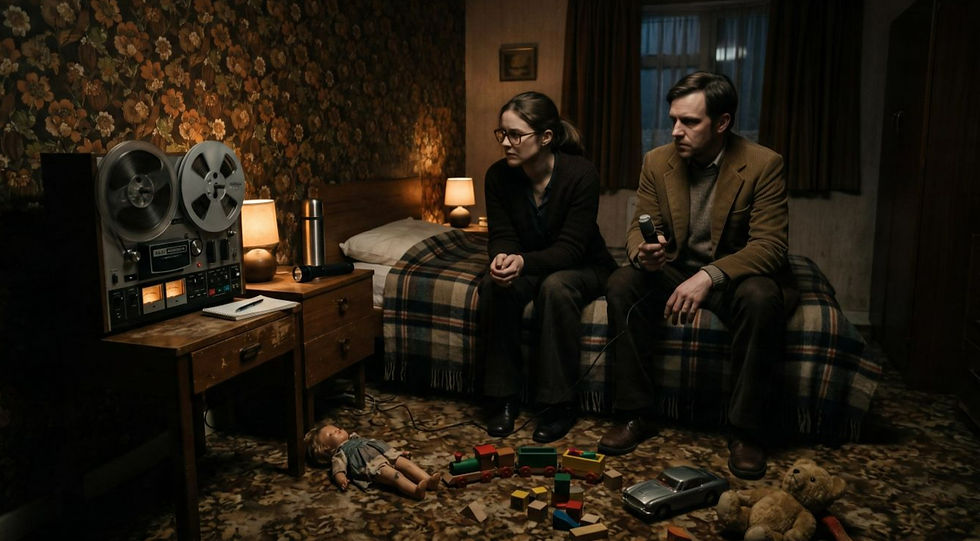
The location shifts to 284 Green Street, Enfield, North London, England. The operational window opens in August 1977. Peggy Hodgson, a single mother, called the Metropolitan Police to her council home after her children, Margaret and Janet, reported furniture moving autonomously.
Society for Psychical Research (SPR) investigators Maurice Grosse and Guy Lyon Playfair took charge of the scene. Over fourteen months, they gathered thousands of audio recordings, photographs, and physical measurements. The Enfield case represents one of the most heavily documented true paranormal stories of the twentieth century. The phenomena included:
Spontaneous acoustic knocks originating from inside structural walls and floors.
Flying household items, including marbles, Lego bricks, and heavy pillows.
Levitation events captured on camera, showing eleven-year-old Janet thrown through the air.
Coarse, guttural vocal fry speaking through Janet. Identifying itself as Bill Wilkins, a man who had previously died in the house.
The scientific consensus leans heavily toward hoaxing. Critics highlight recordings where the girls were caught bending spoons manually. They also note that the Bill voice used vocal structures Janet could have easily faked. But Grosse and Playfair maintained that while the children did play pranks, they were mimicking a genuine, terrifying force they couldn't control. It’s like trying to explain away a house fire because a kid dropped a match. The scale of the destruction didn't match the alleged culprit.
For an in-depth look at this haunting, read our the Enfield Haunting breakdown.
3. The Tower of London: Royal Intelligent Anomalies
The location is the historic fortress on the north bank of the River Thames, London, England. The timeline spans nearly a thousand years of political executions, imprisonment, and torture.
High-Density Haunting Zones: Tower of London
├── Wakefield Tower (Henry VI)
├── Bloody Tower (The Little Princes)
└── Green Tower (Anne Boleyn)
The Tower of London is a prime environment for intelligent hauntings, where entities interact directly with the environment and living witnesses. Guards and Yeoman Warders have filed official reports for centuries. The most prominent files include:
Anne Boleyn: Observed frequently near the Queen's House and the chapel of St Peter ad Vincula. Often described as a moving, elegant figure holding her severed head.
The Little Princes: Edward V and Richard of Shrewsbury, reported by sentries as two children in nightgowns huddled together in the Bloody Tower. Appearing terrified when approached.
The White Tower Bear: A massive, dark shape encountered by a guard in 1816. The sentry lunged with his bayonet, which passed clean through the form. The guard died of shock two days later.
The structural composition of the Tower of massive stone walls, damp river air, and iron fittings, creates an ideal battery for storing high-trauma events. Whether these are psychic imprints or conscious entities remains a subject of intense debate among paranormal historians.
For an in-depth look at this haunting, read our Ghosts of the Tower of London breakdown.
4. Glamis Castle: Secret Chambers and Scottish Demons
The location is Glamis, Angus, Scotland. The castle has been the home of the Lyon family since the 14th century.
Glamis is infamous for the Monster of Glamis, a horribly deformed heir kept hidden in a secret chamber within the fourteen-foot-thick stone walls. But the primary paranormal activity centers on the Grey Lady. Believed to be Janet Douglas, Lady Glamis. King James V burned her at the stake for witchcraft in 1537 on purely political charges.
Her spirit manifests above the altar in the family chapel. Witnesses describe a profound, overwhelming sense of sorrow that blankets the room before she appears. This case highlights how intense historical injustice can burn an energetic scar into a location. Creating an intelligent haunting that seems trapped in a cycle of perpetual grief.
5. 30 East Drive: The Black Monk of Pontefract
The location shifts to a mundane council house in Pontefract, West Yorkshire, England. The operational window opened in 1966 when the Pritchard family moved into the property.
The family quickly encountered an aggressive poltergeist breakout, later colloquially dubbed Fred or the Black Monk of Pontefract. Jean and Joe Pritchard, along with their children Philip and Diane, documented severe spatial anomalies. Objects were thrown across rooms, green slime oozed from taps, and family members experienced extreme, localised drops in temperature.
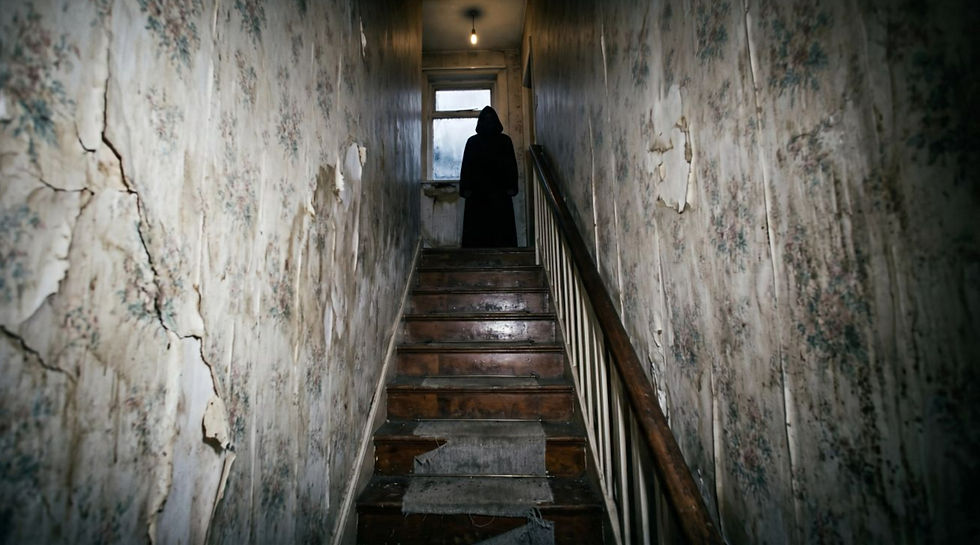
The activity focused with alarming intensity on twelve-year-old Diane. In one heavily documented event. Physical forces literally dragged the girl up the stairs by her hair, leaving visible throat markings that resembled manual strangulation. Local historical research suggested the house was built adjacent to an ancient town gallows site. Investigators categorise this case as a highly malevolent intelligent haunting rather than a passive loop. As the entity directly reacted to attempts at exorcism by increasing its destructive output.
For more information, take a look at our 30 East Drive Breakdown.
6. 50 Berkeley Square: The Fatal Room of Mayfair
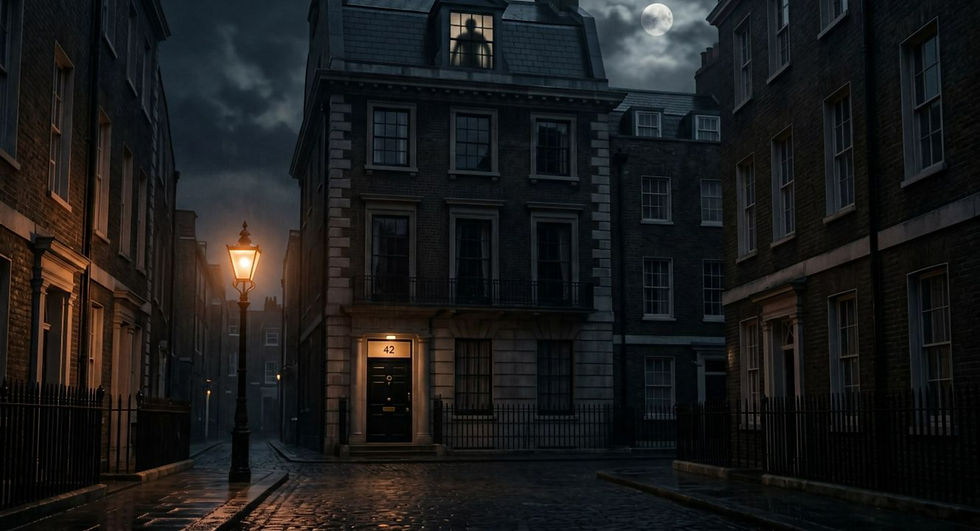
The location is a four-storey townhouse in Mayfair, London, England. The timeline of terror peaked during the 19th century, particularly during the residency of Thomas Myers in the 1870s and subsequent lets.
50 Berkeley Square Attributed Casualties
1870s: Thomas Myers (Died in isolation/madness)
1879: Maidservant (Driven to insanity, died in asylum)
1879: Captain Kentfield (Found dead of shock in the attic room)
1887: Two sailors from HMS Penelope (One fell to death escaping, one found dead)
The property gained historical notoriety for its top attic room. Witnesses who spent the night inside this chamber routinely encountered an indescribable, amorphous shadow or a slimy creature that induced lethal panic. In 1879, a maidservant ran from the room screaming and died in an asylum the following day.
Soon after, a brave visitor named Captain Kentfield volunteered to sleep in the room armed with a rifle. Witnesses heard a single shot in the night and found him dead from sheer fright. Skeptics suggest the legends were amplified by the eccentric, reclusive behavior of Myers, who let the house fall into decay. However, the consistent physiological reaction of victims, dying with their eyes wide open in frozen terror, hints at an active, predatory anomaly.
To dive deeper into this haunting, read our 50 Berkeley Square breakdown.
7. The Demon Drummer of Tedworth: The 17th-Century Drum Beats
The location is Tedworth, Wiltshire, England. The historical timeline begins in March 1662 when local magistrate John Mompesson confiscated a drum from an unlicensed vagrant and former soldier named William Drury.
After Mompesson deposited the drum at his manor house, a violent poltergeist campaign commenced. For over a year, the household was subjected to persistent, thunderous drumming sounds that echoed through the structure. Mimicking military cadences. The phenomena rapidly expanded to include floating beds, flying shoes, and invisible entities scratching at the children's bedposts.
And the narrative grew stranger when King Charles II sent royal commissioners to investigate the house. Drury, who was imprisoned on separate charges, boastfully claimed he had cast a spell of witchcraft on the magistrate using the drum. This case stands as one of the earliest formally recorded poltergeist outbreaks in British history. Illustrating that these auditory anomalies have been tracking human populations long before modern psychological theories were invented.
8. Raynham Hall: The Forensic Origin of the Brown Lady
The location is a grand country house in Norfolk, England. The timeline spans centuries of ownership by the Townshend family, but the core historical anomaly focuses on Lady Dorothy Walpole. Who died officially of smallpox in 1726.
Raynham Hall Photographic Event
Date: September 19, 1936
Photographers: Captain Hubert C. Provand and Indre Shira
Equipment: Standard plate camera
Result: The "Brown Lady" descending the staircase image
Dorothy was allegedly locked in her rooms by her husband, Lord Townshend, after he discovered her infidelity. Her spirit, known as the Brown Lady due to the brown brocade dress she wears. Has been seen by numerous high-credibility witnesses. Including George IV and Captain Frederick Marryat, who actually fired a pistol at her glowing face in a corridor.
But the case achieved global scientific prominence in September 1936. Photographers Provand and Shira were documenting the staircase for Country Life magazine when a misty, shrouded form began moving down the steps. They captured a photograph that has withstood decades of forensic analysis. Skeptics claim it is a double exposure, but physical examinations of the negative failed to find evidence of darkroom manipulation. Cementing Raynham Hall as a critical baseline for photographic anomalies.
9. The Old Man of Halsall Moss: The Shadow in the Peat
The location is the low-lying agricultural wetlands of Halsall Moss, Lancashire, England. The primary timeline is rooted in nineteenth-century agricultural developments when local workers began extensively draining the deep peat mosses.
Field workers and remote cottage residents began filing accounts of a large, misshapen dark entity roaming the lonely ditch lines and lanes at dusk. The figure was described as a stooping, ancient man covered in rags or earth. Who dissolved into thin air when approached. Local folklore attributed the sightings to the restless spirit of a murdered traveler whose body was concealed in the marsh.
From an investigator's standpoint, this case is highly indicative of atmospheric or geographic recording. Peat bogs possess unique chemical preservation properties (basically acting as natural mummification tanks) and high carbon densities. It is entirely plausible that the swampy geography of Halsall Moss served as an exceptional conductive medium. Locking in the final, terrified moments of an forgotten life and replaying the visual data to rural witnesses centuries later.
10. The Witch of Scrapfaggott Lane: The Displaced Boulder Hysteria
The location is Great Leighs, Essex, England. The timeline centers on October 1944, during the height of the Second World War, providing a remarkably modern look at localised folklore and physical disturbances.
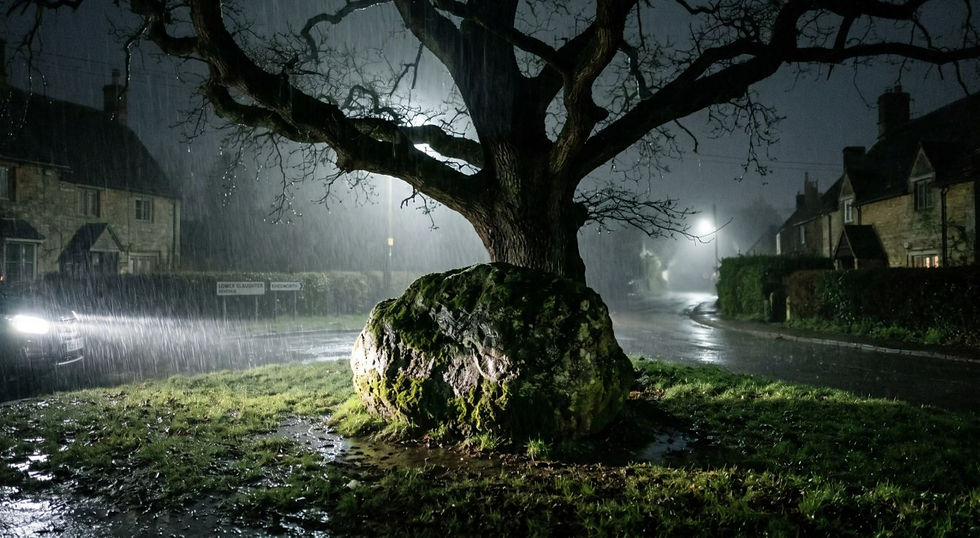
During road widening operations near Scrapfaggott Lane, a massive, unhewn stone boulder was moved by a US Army bulldozer. This stone was historically known as the burial marker of a 17th-century witch who had been staked through the heart and buried at the crossroads.
Immediately following the stone's displacement, the village experienced an unprecedented wave of poltergeist activity.
Heavy farm gates were lifted off their hinges and swapped overnight.
Chickens were mysteriously transferred from their coops into locked barns.
Loud, invisible footsteps trod the lanes, accompanied by the sounds of cackling.
The escalating chaos forced local officials to take action. Harry Price's associates advised that the environmental balance could only be restored by returning the physical anchor. On a dark night, a team of villagers dragged the boulder back to its original geometric coordinates. The disturbances ceased instantly. This case demonstrates how a physical object can act as a seal or ground wire for regional anomalies. And how disturbing that stone can literally unleash latent historical trauma.
We must recognise that these ten locations represent more than mere ghost stories. They are anomalies that defy simple materialist explanations. The sheer volume of matching eyewitness testimony across centuries suggests a physical or psychological mechanism we do not yet fully understand.
I challenge you to step away from the comfort of your spreadsheets and look at the raw data out in the field. Go visit one of these sites yourself. Pay attention to the sudden drops in temperature, the unexpected drafts, and the heavy air. What will it take for you to accept that some scars on the land never truly heal?
Extra Facts About The Top 10 UK Hauntings
What happened at 30 East Drive in Pontefract?
In 1966, the Pritchard family experienced a highly aggressive poltergeist breakout known as the Black Monk of Pontefract. The activity included substantial physical manipulation of objects, levitation, and instances of physical assault. Making it one of the most violent intelligent hauntings recorded in modern English history.
Why is 50 Berkeley Square called the most haunted house in London?
The Mayfair townhouse earned its reputation during the 19th century due to terrifying encounters inside its top attic room. Multiple witnesses, including a maidservant and a visiting captain. Reportedly died of sheer shock or were driven to insanity after encountering an unknown, malevolent entity inside the room.
Who was the Demon Drummer of Tedworth?
The Demon Drummer of Tedworth was a famous 1662 poltergeist case in Wiltshire, England. After a magistrate confiscated a drum from an unlicensed vagrant. The magistrate’s house was subjected to over a year of invisible drumming noises, moving furniture, and phantom disturbances. Which were later investigated by royal commissioners.
Is the Raynham Hall Brown Lady photo real?
The famous Brown Lady photograph taken in September 1936 by photographers from Country Life magazine. It remains one of the most credible pieces of ghost hunting evidence in history. Forensic examinations of the original negative have consistently failed to find proof of darkroom fraud, double exposure, or physical manipulation.
What triggered the Witch of Scrapfaggott Lane haunting?
The haunting was triggered in October 1944 when an American army bulldozer displaced a historic boulder at a crossroads in Great Leighs, Essex. The stone served as the burial marker for an alleged 17th-century witch. Its removal immediately unleashed an intense wave of regional poltergeist activity until the stone was returned.
What is the difference between a residual haunting and an intelligent haunting?
A residual haunting functions like an environmental recording where a past traumatic event plays back in a loop. The entity cannot interact with its surroundings. An intelligent haunting involves a conscious entity that is aware of its environment, responds to stimuli, and actively attempts to communicate with or manipulate living witnesses.
Where is the most haunted house in the UK?
Historically, Borley Rectory in Essex was dubbed The Most Haunted House in England by researcher Harry Price due to hundreds of documented anomalies. Although the original building burned down in 1939. The site and nearby church remain major areas of study for persistent residual energy loops.
Is the Enfield poltergeist case real?
The Enfield poltergeist case remains highly controversial. While Society for Psychical Research investigators collected massive amounts of audio and photographic evidence of levitation and acoustic anomalies. Modern scientific consensus suggests the children hoaxed many of the phenomena for attention or amusement.
Can stone buildings store paranormal energy?
According to the Stone Tape Theory. Certain minerals within structural materials, such as quartz in limestone or sandstone. Can absorb high-amplitude emotional energy during traumatic historical events. This stored energy is later released or triggered by specific environmental factors, creating a residual haunting loop.
What is the oldest haunted pub in Wales?
The Skirrid Mountain Inn in Monmouthshire is considered one of the oldest and most haunted pubs in Wales. Its long history as a courtroom where roughly 180 rebels were hanged from an internal oak beam has left behind a legacy of aggressive physical anomalies and dark intelligent hauntings.
Take a look at the Society for Psychical Research (SPR) archives for their historical case summaries on the major British anomalies in this article. You can also check out the Uncanny Cold Cases episode The Black Monk of Pontefract on the BBC website.
Sources and Further Reading
Price, Harry. (1940). The Most Haunted House in England: Ten Years' Investigation of Borley Rectory. Longmans, Green & Co.
Playfair, Guy Lyon. (1980). This House is Haunted: The True Story of the Enfield Poltergeist. Souvenir Press.
Mompesson, John. (1663). Official Deposition to the Wiltshire Magistrates regarding the Tedworth Disturbance.
Townshend Family Papers. (Historical Archive). The Correspondence and Journals of Raynham Hall. Norfolk Records Office.
Society for Psychical Research. (Archives). The 50 Berkeley Square and Pontefract Case Files. London.

Comments