
The Ghostly Nun of Borley Rectory: Inside England's Most Haunted House
Updated: Sep 1
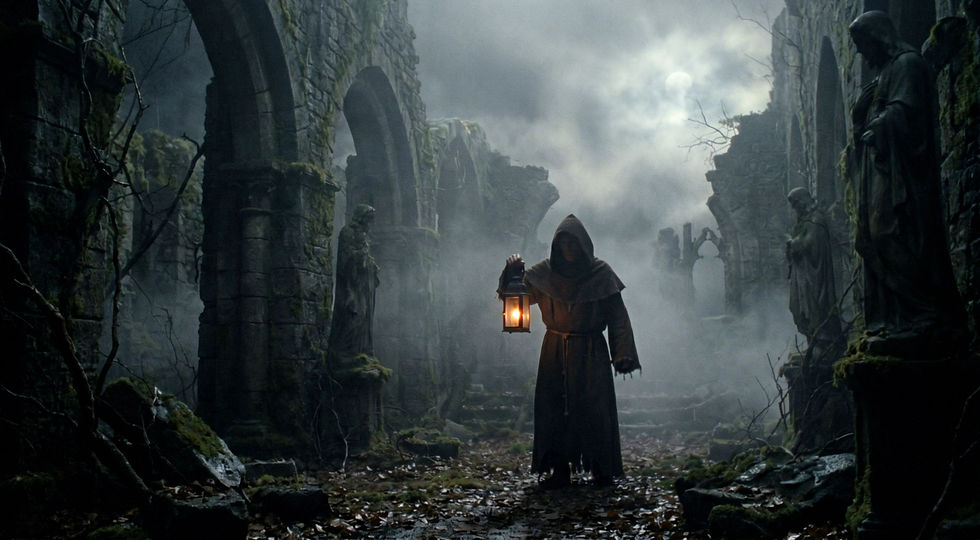
Four young women stood frozen by the edge of a dark, overgrown garden pathway on a chilly autumn afternoon. They watched a somber figure clad in the traditional robes of a nun drift silently across the lawn in broad daylight. The figure did not walk so much as float. Her head bowed in deep sorrow, completely ignoring the terrified onlookers before vanishing into thin air. This was not a campfire tale told to frighten children, but a recurring reality for the daughters of the Reverend Henry Bull.
The bizarre sighting marked the beginning of decades of paranormal activity at Borley Rectory. An estate that would eventually earn the dark reputation of being the most haunted house in England. But what exactly was driving these terrifying anomalies? Could a modern investigation separate genuine historical facts from clever trickery?
While researching this case, you can explore our complete database of phenomena over on our master Ghosts and Hauntings Archive.
1863 — The Construction of a Haunted Legacy
To understand this historical case file, we honestly have to look back to 1863. That was the year the Reverend Henry Bull built a sprawling, unimposing brick vicarage near the quiet town of Sudbury, Essex. He designed it to house his massive family of fourteen children, thinking it would be a peaceful countryside home. The rectory, however, was erected directly on the historic grounds of an ancient Benedictine monastery with a distinctly unholy reputation.
Local folklore tells a grim story about the old monastery grounds. Centuries earlier, a Borley monk allegedly seduced a beautiful local nun, and the two star-crossed lovers tried to elope. They were caught by the monastic authorities before they could escape. The monk was promptly executed, and the nun suffered a far more gruesome fate. She was bricked up alive inside the dark stone walls of the cellar.
It seems the ground was thirsty for tragedy long before the brickwork was even finished. Historical archives show that a 17-year-old local labourer named John Whyard tragically drowned in the nearby river during the 1863 construction phase. Superstitious villagers immediately murmured that the rectory was cursed from day one, viewing the boy’s sudden death as a terrible omen for what was to come.
But here is where we have to separate documented history from sheer folklore. It turns out this entire tragic backstory about the Benedictine monastery was officially debunked in 1938. Researchers confirmed there was never a monastery on that plot of land, and historians now suspect the Bull children essentially invented the romantic tale after reading popular gothic novels of the era.
The Bull Family and the Early Sightings
The chilling manifestations began almost as soon as the Bull family unpacked their bags. Strange noises echoed through the hallways after dark. Starting with heavy, dragging footsteps in totally empty rooms and quiet whispering voices that seemed to drift out of the woodwork.
Reverend Bull became deeply intrigued by the phenomenon. He actually built a small summerhouse facing the garden path where the spirit appeared most frequently. A track the family quickly dubbed "Nun’s Walk". From this vantage point, he spent cold nights watching the weeping materialisation wander through the gardens. Searching in vain for her lost lover.
The family regularly invited friends over to join their eerie vigils. Few visitors had the stomach to stay long. One terrifying evening, a guest woke up to see the ghostly nun peering directly through the ground-floor bedroom window. This caused the panicked visitors to cut their trip short. A close friend staying at the house later logged a report of stones throwing themselves about the rooms. He witnessed boots mysteriously appearing on top of tall wardrobes, and had multiple face-to-face encounters with the spectral nun.
The family grew accustomed to the hauntings over the decades. The Reverend’s son, Harry Bull, took over the rectory as the new incumbent from 1892 until his death in 1927. Both Harry and his sisters regularly witnessed the nun. Along with a spectacular phantom coach drawn by two bay horses that would gallop wildly up the driveway before vanishing into thin air.
Tragedy seemed to linger in the master bedroom. The elder Reverend Bull died in the house’s famous Blue Room in 1892. His son Harry passed away in that exact same room thirty-five years later. (His sister, Miss Ethel Bull, later reported that she saw a tall phantom figure standing at the foot of her bed on multiple occasions. Alongside a persistent feeling that something invisible was sitting right on the mattress beside her.) The relentless barrage of headless coachmen, poltergeist activity, and graveyard chill eventually forced the surviving Bull children to pack up and abandon the family home.
1927 — The Arrival of the Smiths and the Daily Mirror Investigation
The Reverend Eric Smith and his wife took up residence at the rectory in the late 1920s. They initially shrugged off the local folklore regarding phantom carriages and sobbing spirits. But they barely had time to settle in before a violent burst of poltergeist activity turned their lives upside down.
The desperate couple contacted the Daily Mirror newspaper for help. On 14 June 1929, the newspaper published a sensational report under the headline "Weird Night in 'Haunted' House". The paper sent a special correspondent along with Harry Price. The director of the National Laboratory for Psychical Research and a legendary ghost hunter, to investigate the claims.
Price was a former music-hall conjurer and a well-known self-publicist who made a career out of exposing fraudulent spiritualists. He secretly dreamed of finding real proof of life after death to secure his legacy among high society. The first night he spent at the rectory with his secretary, Miss Lucy Kaye, and the Smiths proved to be completely chaotic.
While standing in the summerhouse at dusk, the reporter spotted a dark, unidentifiable figure moving stealthily through the deep shadows of the lawn. He ran to catch it, but the figure vanished instantly. As the group walked back to the main house, a sudden crash echoed through the courtyard as a heavy pane of glass was thrown from the porch roof. They rushed inside to check the locked room directly above the porch but found absolutely no one there.
Moments later, as they walked down the main staircase, a heavy object flew right past the reporter’s head. It smashed violently against an iron stove in the entrance hall. Using their flash lamps, they examined the broken shards and realised it was a red glass vase. It had been sitting securely on the mantelpiece of the Blue Room upstairs. A room they had just searched and locked. Price was walking directly behind the reporter, making it physically impossible for him to have thrown the item at such an angle.

The activity continued into the early hours of the morning:
As they sat in the pitch dark, a common mothball materialised out of mid-air and hit the reporter's hand.
From 1:00 AM until nearly 4:00 AM, the entire group questioned the unseen entity out loud.
The spirit responded with loud, distinct raps on the back of a mirror.
A heavy cake of soap was lifted from a washstand and slammed into a china jug with enough force to deeply dent the soap, while everyone was standing on the opposite side of the room.
The terrifying experience shattered the Smiths' nerves. They decided to sell up and move out within two years. Though subsequent investigations unearthed private letters from the Reverend Smith confirming he was absolutely convinced Borley was genuinely haunted.
1930 — The Foyster Era and Intense Poltergeist Attacks
The next chapter of the historical case file began in 1930. When the Reverend Lionel Foyster moved in with his wife, Marianne, and their young daughter, Adelaide. The entities inside the house immediately intensified their efforts. Shifting from simple noises to aggressive, targeted physical attacks.
Penciled messages began to manifest mysteriously on the plaster walls. Most were messy scrawls, but a few were legible. Pleading notes like "Marianne light mass prayers" or simple cries for help. Heavy books, framed paintings, and kitchen crockery regularly flew through the air or moved from room to room entirely on their own. Doors locked themselves from the inside without any keys.

Some of the anomalies were downright bizarre, earning the house the local nickname of harboring a "potato-geist". One night, Lionel and Marianne were in the kitchen watching their servant girl boil a massive iron pot of potatoes. The servant briefly stepped out of the room, and when she returned, the water was still boiling furiously, but every single potato had instantly vanished into thin air.
Harry Price returned to the rectory at the invitation of the family. He recorded instances of phantom footsteps and terrifying physical assaults. On one notable occasion, an invisible assailant physically flipped a mattress, throwing Marianne Foyster completely out of her bed.
The Reverend Foyster attempted to have the entire house formally exorcised by religious authorities, but the ritual did nothing to calm the chaos. Heavy servants' bells rang frantically on their own walls, and haunting organ music drifted from the completely empty chapel building. Admitting complete defeat. The Foysters packed their belongings and left the spooks in peace. Price secretly believed that a large portion of the activity during this era was being caused or amplified by Marianne Foyster herself, so he decided to take matters into his own hands.
1937 — The Tenancy of Harry Price
In 1937, Harry Price officially rented Borley Rectory for a year to conduct the first structured scientific investigation of the property. He placed a public advertisement in The Times asking for open-minded, professional volunteers. Specifically targeting doctors, engineers, and army officers, to act as official observers.
He set up a rotating shift system to monitor every square inch of the house. Over the course of twelve months, his teams reported an array of unexplained phenomena:
Sudden, unexplained drops in temperature and icy drafts in closed rooms.
Strange, chemical odors that would appear and disappear instantly.
New wall-markings and pencil writings appearing while rooms were being watched.
Ghostly lights moving past unlit windows at night.
Essentially, it was like trying to catch smoke with your bare hands. While the observations were highly detailed, the results remain deeply controversial among modern researchers. Skeptics later alleged that Price was not above using a bit of old-fashioned music-hall trickery to boost his findings and ensure his ongoing fame.
1939 — The Prophesied Destruction
The final, dramatic act of the Borley Rectory saga took place on a cold night in 1939. A year after Price ended his official tenancy, the property had passed to new owners who fared little better with the lingering spirits.
During a spiritualist séance conducted on the grounds by Price eleven months earlier, a spirit communication had explicitly predicted that the rectory would be destroyed by a catastrophic fire. The prophecy came true with terrifying precision when a mysterious blaze broke out and rapidly consumed the entire wooden and brick structure.
As the local community gathered to watch the historic building burn. Several witnesses swore they saw ghostly, translucent phantoms moving calmly among the roaring flames. The most haunting sight reported that night was the pale, weeping face of the ghostly nun, staring out at the crowd from a top-floor window as the roof collapsed around her.
The physical mystery deepened significantly in 1943 when the remaining burnt ruins were officially demolished and fully excavated. Digging down to a depth of three feet in the old cellar, excavators pulled out the physical remains of a young female skull. Price triumphantly claimed this proved the nun legend, though cynical local records later snidely reported that the bones belonged to nothing more than a stray pig.

The Skeptical Backlash and the War on Harry Price
The story of Borley Rectory did not burn out with the fire of 1939. In 1940, Harry Price published his definitive findings under the bold title The Most Haunted House in England. He boasted to his readers that the text presented the best authenticated case of haunting in the annals of psychical research. The book became an instant bestseller. Offering a fascinating bit of escapism during the dark, anxious opening months of the Second World War. Basically, Price single-handedly established a brand-new non-fiction genre. The haunted house mystery.
The blockbuster success generated a wave of similar books by self-proclaimed experts, but it also painted a massive target on Price’s back. He revelled in his newfound fame until his sudden death in 1948, having spent forty years trying to provide irrefutable evidence of the paranormal.
During the 1950s, the ghost hunter was completely denied his peace. A series of spiteful personal attacks on his reputation were launched by rival researchers who claimed he had faked the most compelling anomalies. The Society for Psychical Research (SPR) launched an aggressive investigation. The committee was led by members who were openly hostile to Price. They concluded that he had actively manipulated historical facts to substantiate his claims.
Even the witnesses began to recant under pressure. Mrs Smith wrote a public letter to the Church Times flatly denying that she or her husband had ever claimed the rectory was haunted. (Local historians actually think she did this simply to ingratiate herself with the Church authorities, who were deeply embarrassed by the ongoing media circus.) The SPR report concluded that almost every single event at Borley had a perfectly rational, natural explanation.
Proving the Anomalies: The Unexplained Evidence
But if Price was a total fraud, the timeline of the historical case file starts to fall apart. Skeptics are left with a massive logical riddle. If Price faked everything to secure a quick cash-out. Why on earth did he rent the empty rectory for a whole year in 1937, only to admit that there was almost nothing anomalous to report? He had total control of the property and a shift team of observers. He had more than enough time and opportunity to stage a spectacular poltergeist show to validate his legacy. Yet he reported minimal activity.
The sudden inactivity suggests a fascinating alternative theory. The entities might have been specifically attracted to the living energy of the original residents. The Reverend Bull and Marianne Foyster perhaps possessed genuine, latent mediumistic abilities that acted like a battery for the phenomena.
And we cannot forget that five separate rectors and their large families logged hundreds of terrifying testimonies before Price ever set foot in Essex. Whatever shortcuts or embellishments Price used to boost his book sales, something genuinely out of the ordinary was happening on those grounds.
Strangely, some of the most compelling evidence for the haunting came from a newspaper team sent to debunk it. The famous novelist Dennis Wheatley later exposed a hidden footnote from the 1950s involving Kenneth Allsop, a book reviewer for the Daily Mail. Allsop had been sent to Borley with a photographer during the height of the media skepticism, instructed by his editor to write a harsh debunking piece.
But when the photographer developed his film in the darkroom, the unmistakable figure of a nun could be clearly seen standing in the shadows of the frame. Allsop excitedly took the photographic evidence straight to his editor. The man stared at the print, turned pale, and whispered, "No, I just daren't print it."
1977 — The Skull-Faced Funeral Party
The paranormal anomalies didn't stop after the building was leveled to the ground. A truly bizarre postscript to the Borley saga occurred decades later on 28 August 1977, when Stephen Jenkins, a prominent ley line expert, visited the quiet parish. He was researching whether the historic manifestations were linked to a spider's web of magnetic ley line alignments cutting through the landscape.
The time was precisely 12:52 PM. Jenkins and his companion, Thelma, were driving southwest along a minor road tracing the northern boundary of the old rectory grounds. Suddenly, four men dressed entirely in black appeared right in front of the car, turning sharply into a gap in the hedge.
The figures were hooded and cloaked, carrying a heavy, old-fashioned black coffin that was ornately trimmed with bright silver. The party possessed an absolute physical presence and a terrifying sense of material reality. Jenkins slammed on his brakes to avoid hitting them.
The two researchers immediately agreed to write separate notes before comparing their notes, ensuring their data wasn't compromised. The independent descriptions tallied exactly. However, Thelma noticed one detail Jenkins missed while braking. The near-left bearer had turned his head directly toward her car. Underneath his dark hood, his face was nothing but a bare, gleaming human skull.
The next day, they returned to the exact spot at 12:52 PM and captured a Kodak colour slide of the gap in the hedge, which led toward the Belchamp Walter churchyard. The developed slide revealed a short, cloaked figure standing in the foliage, its head lowered to reveal a distinct, skull-like dome. Strangely, there is absolutely no local folklore or legend of a phantom funeral in the parish, though Jenkins guessed from the garments that the spectral bearers belonged to the late 14th century.

Evaluating the Theories: Legend vs. Logic
How do we explain a century of pure chaos? Paranormal historians have floated several compelling theories to explain the dark energy of the site:
The Monastic Curse: A psychic medium during a closed séance at the rectory claimed that the legendary nun wasn't from folklore at all. They claimed she was actually a young woman murdered 300 years earlier on the spot by a member of the wealthy, historically prominent Waldegrave family.
The Flooded Crypt: In 1988, construction workers discovered a deep, hidden crypt prone to severe flooding directly under the neighboring Borley Church. Structural experts note that shifting water levels in underground chambers can create deep, echoing structural groans and sudden drops in localised air pressure. This might explain the dragging footsteps and the sudden sensations of graveyard cold reported by the rectors.
The Pseudoscience Grid: The 1977 Jenkins sighting suggests the rectory sat on an active intersection of energetic ley lines. Creating a permanent portal that caused different eras of history, from 14th-century funerals to Benedictine spirits, to bleed into our modern reality.
Ultimately, the true answer behind Borley Rectory remains buried beneath the ash and soil of Essex. It stands as a brilliant, frustrating monument to the classic haunted house mystery. Forever balancing on the razor's edge between documented human testimony and rational scientific skepticism.
Modern Discoveries: The Enigma In The 21st Century
The legacy of the rectory refuses to stay buried, bleeding heavily into modern pop culture. A massive historical find occurred when a hidden collection of Reverend Harry Bull's personal relics was discovered in the loft of the nearby Borley Church. The cache included original watercolours of the rectory and a handwritten letter detailing their very first 1900 encounter with the ghostly nun, proving the family wasn't just making it up for Harry Price.
The cinematic draw of the property remains incredibly potent too. A recent feature film titled Borley Rectory: The Awakening won Best Thriller at the National Film Awards. Because the original site is long gone, the award-winning crew shot the movie at Ingatestone Hall, another notoriously haunted Essex manor. Today, the active haunting has merely migrated a few yards down the road into the ancient 12th-century Borley Church. Where paranormal investigators still regularly report phantom organ music and disembodied footsteps whispering through the cemetery.
Borley Rectory Frequently Asked Questions
Is Borley Rectory still standing?
No, Borley Rectory is no longer standing. The building was completely destroyed by a catastrophic fire in 1939, which had been explicitly predicted by a spirit during a séance eleven months earlier. The remaining ruins were eventually demolished.
Who was the ghost hunter at Borley Rectory?
The primary investigator was Harry Price, the director of the National Laboratory for Psychical Research. Price was a former music-hall magician who specialised in exposing fraudulent mediums, though his own findings at Borley were later criticised by rivals.
What is the legend of the Borley Rectory nun?
Local folklore states that a medieval monk seduced a nun from a nearby monastery. After a failed attempt to elope, the monk was executed and the nun was bricked up alive inside the cellar walls, leaving her spirit to haunt the grounds.
Did Harry Price fake the evidence at Borley?
The Society for Psychical Research (SPR) conducted a hostile review in the 1950s concluding that Price had manipulated certain facts. However, many anomalies were documented by independent witnesses both before Price arrived and decades after his death.
What happened to Marianne Foyster at the rectory?
During her residency in the 1930s, Marianne Foyster was the target of aggressive poltergeist attacks, including being thrown out of her bed by an invisible force. Investigators suspected she may have unconsciously generated or amplified the phenomena.
Can you visit the Borley Rectory site today?
While the parish of Borley and the nearby church still exist, the actual site of the rectory is private property. The neighboring Borley Church remains standing, where visitors still occasionally report strange sounds and organ music.
What was the "potato-geist" incident at Borley Rectory?
This refers to a famous 1930 poltergeist event where a whole pot of potatoes completely vanished from a boiling pot of water while the servant girl's back was turned.
Did they ever find bodies at Borley Rectory?
Yes. During a 1943 excavation of the demolished ruins, investigators discovered skull fragments belonging to a young woman buried three feet deep in the cellar floor, though skeptics argued they were animal bones
Sources and Further Reading
Price, Harry. (1940). The Most Haunted House in England: Ten Years' Investigation in a Famous Rectory. Longmans, Green & Co.
Society for Psychical Research. (1956). The Borley Report: A Critical Evaluation of the Evidence. SPR Archives.
Wheatley, Dennis. (1959). Private Papers and Occult Footnotes: The Allsop Encounter. Hutchinson & Co.
Jenkins, Stephen. (1978). The Spider's Web: Ley Lines and Phantom Manifestations in Essex. Countryside Books.


Comments