
The KiMo Theatre Ghost: The Truth Behind the Albuquerque Doughnut Curse
An entire theatrical cast stood in the wings of a crowded New Mexico stage. Completely paralysed by a bizarre, aggressive sequence of physical disasters unfolding right under the glare of the spotlights. Without warning, heavy stage equipment plummeted from the high ceilings. Glass light bulbs exploded into cascades of shards, and well-anchored set pieces toppled forward as if intentionally pushed by invisible hands. Actors forgot lines they had spoken flawlessly for weeks. Doors and windows flew open by themselves, and several performers were violently tripped and pushed flat to the floor layout by an unseen entity. This chaotic performance was witnessed by hundreds of startled patrons.
The disaster marked the legendary awakening of the ghost of the KiMo Theatre. An incident widely cited by amateur investigators as the most heavily witnessed public poltergeist outbreak in history. But what exactly was driving this public sabotage? Could a rigorous forensic investigation separate a genuine supernatural presence from typical theatrical lore and human misremembering?
While researching this case, you can explore our complete database of phenomena over on our master Ghosts and Hauntings Archive.
1926 — The Architectural Jewel of Albuquerque
To understand this southwestern haunting, we honestly have to look back to 1926. That was the year the KiMo Theatre was constructed in downtown Albuquerque, New Mexico, officially opening its doors to the public the following year. The building's layout is visually spectacular, combining flamboyant Art Deco style with traditional Native American motifs to create one of the city's best-known architectural landmarks.
To understand this southwestern haunting, we honestly have to look back to 1926. That was the year the theatre was constructed by entrepreneur Oreste Bachechi. To give the building a completely unique identity, city leaders launched a public naming contest in 1927. The winning entry was submitted by Pablo Abeita, the Governor of Isleta Pueblo, who proposed the name "KiMo." In the native Tiwa language, the term translates literally to "mountain lion", though local promotional materials of the era liberally marketed the phrase as meaning "king of its kind."
The building's layout is visually spectacular, serving as the premier pioneer for a highly specialized, short-lived architectural movement known as Pueblo Deco. This unique style explicitly fuses the geometric lines of flamboyant Art Deco with traditional Native American symbols, featuring skull reliefs, ceiling murals mimicking Navajo blankets, and hand-carved row indicators. Over the decades, however, the structure earned a much darker reputation as one of the most heavily discussed haunted places in New Mexico.
Its resident spirit became the subject of dozens of terrifying articles, book chapters, and investigations by local ghost hunters. Despite this massive notoriety, a close, rigorous investigation into the facts behind the phantom was never actually conducted until a detailed historical audit took place in 2008.
2 AUGUST 1951 — The Tragic Boiler Explosion
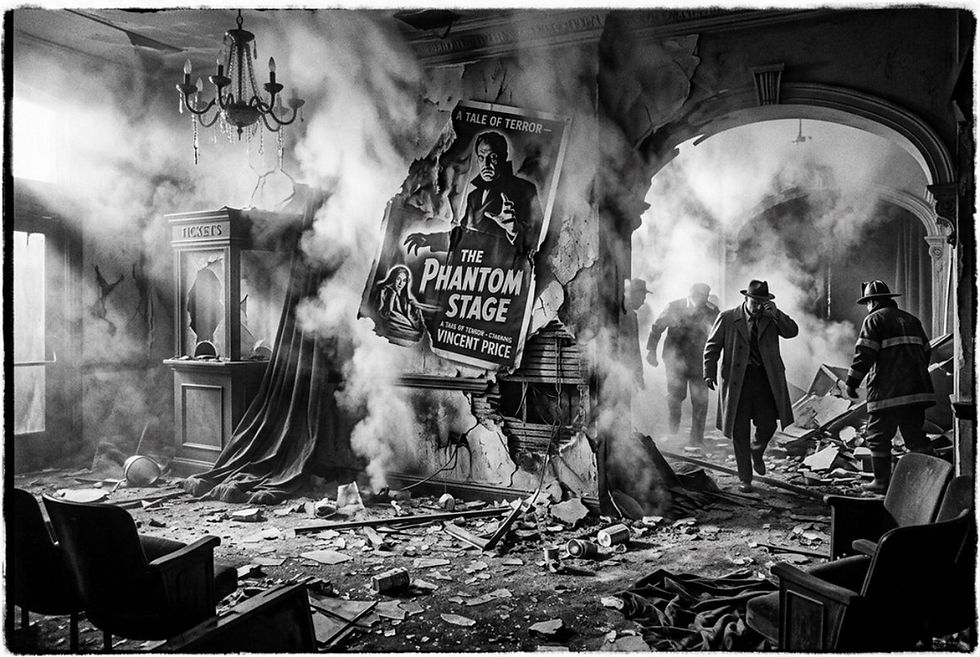
While the ghost-ruined play was widely rumored to have taken place in 1974, the true origin of the tragedy dates back twenty-three years earlier. On 2 August 1951, about 1,000 excited patrons packed into the theatre layout to watch the Abbott and Costello comedy film Comin' Round the Mountain. Just as the film started rolling. A massive water heater boiler tucked directly underneath the lobby staircase exploded with a deafening boom.
The violent blast shot jagged chunks of plaster, scalding steam, and flying glass fragments straight through the crowded lobby space. The ensuing chaos was total, leaving eight people severely injured. One adult survivor, Corporal Mike Tullio, suffered horrific cuts and abrasions covering his body that eyewitnesses noted "resembled shotgun wounds," costing him his right eye.
Frank Ellis, an 18-year-old patron sitting four rows from the back, described the panic: "All of a sudden I heard a boom... Some people were screaming... A lady was lying on the floor; she must have had a broken leg. 'Am I dead? Am I dead?' she kept saying."
Tragically, the most seriously injured victim was six-year-old Robert "Bobby" Darnall Jr. Bobby had entered the balcony with two childhood friends, but he became frightened by a loud, piercing siren sound effects in the movie and ran down the stairs to find safety. The boiler exploded the exact second he entered the lobby. According to the 3 August edition of the Albuquerque Journal, the poor child's head and face were crushed as the immense pressure of the blast hurled him directly into a solid wall. A defective thermostat was eventually blamed for the structural disaster.
1974 — The Supposed Sabotage of A Christmas Carol
The theatre was repaired, funeral services were held for little Bobby, and the venue soon reopened to the public under the old theatrical maxim that "the show must go on". For thirty-five straight years, absolute silence followed; there were zero reports of ghostly activity or poltergeist disruptions inside the building.
The silence evaporated when Jewel Sanchez, an employee who spent 14 years working at the KiMo starting in 1979, gave a chilling account to ghost story collector Antonio Garcez for his book Adobe Angels: The Ghosts of Albuquerque. Sanchez claimed that on Christmas Day in 1974, a supernatural entity completely sabotaged a performance. She stated: "All sorts of weird and negative stuff began to happen. Anything that could go wrong, did go wrong."
The entity's behavior closely mirrored classic poltergeist activity. A German term for a "noisy ghost" known to move objects through the air and cause general mischief. Stage lights popped for no reason, doors opened and closed by themselves, electrical cables erupted in storms of sparks, and actors were locked inside their dressing rooms.
The Vengeful Doughnut Offerings
The sole source of this specific, detailed legend was Dennis Potter, the theatre's technical manager. Potter claimed to be a first-person eyewitness to the 1974 disaster, adding a bizarre detail involving the play's director, Andrew Shea. Just before Christmas, the New Mexico Repertory Theater Company was allegedly staging A Christmas Carol. Shea noticed that a sequence of sweet doughnuts had been hung up against the raw brick wall at the back of the stage and, viewing it as untidy, ordered them taken down and tossed into the garbage.
Potter claimed this act doomed the production, as the doughnuts had been left as a protective offering to appease the vengeful poltergeist of Bobby Darnall. Within fifteen minutes, the entity unleashed its wrath. Stunned by the technical disruptions, the director apologised to the crew, bought a fresh batch of doughnuts, and hung them all over the building. The next performance went off without a single hitch.
From that moment on, a strict theatre tradition developed. Doughnuts were left out daily for the child ghost. In 1988, the website HauntedHouses.com reported that something unseen helped itself to the treats, leaving tiny, distinct human bite marks on the food. To pamper their little ghost, crew members hung doughnuts continuously from a water pipe running along the back wall of the stage area.
Writer Scott Johnson claimed that if these treats were ever removed or forgotten, disaster immediately struck the technical effects rigs, accompanied by the eerie sound of child-like laughter echoing through the empty dressing rooms. Over time, the shrine was moved near the dressing rooms, where people left toys, theatre tickets, ballerina shoes, and treats to keep the spirit happy.

The Balcony Phantom: The Second Resident Entity
While little Bobby remains the primary focus of modern Albuquerque paranormal investigations, seasoned theatre staff maintain that the building harbors a second, lesser-known entity. For decades, guests sitting in the balcony or walking the upper corridors have reported encountering the fleeting, mist-like apparition of an elegant woman. Local folklore traces this second haunting back to an old second-floor cafe that once operated on the premises, where a female patron allegedly collapsed and died. Unlike the disruptive poltergeist activity attributed to the stage area. This phantom is described as a quiet, residual presence that aimlessly wanders the upper tiers before vanishing into the brickwork.
Visualising the Ghost: The Striped-Shirt Apparition
When amateur ghost hunters claim to catch a rare visual glimpse of Bobby Darnall's spirit, the description across various urban legends remains remarkably consistent. Rather than a terrifying phantom, the child is almost always reported wearing a classic mid-century outfit consisting of a striped shirt and blue jeans. Witnesses typically claim to see this distinct silhouette standing at the top of the lobby staircase or peer out from behind the heavy velvet curtains of the balcony. The exact locations the young boy frequented just moments before the historic water heater disaster occurred.
The Investigation: Debunking the Timeline
All of this made for an incredibly compelling piece of folklore, but the moment investigators applied factual analysis to the timeline, the entire narrative collapsed. The first step in unravelling the mystery was verifying the key date of the doomed performance.
Garcez's book stated the play occurred on 25 December 1974. However, archival newspaper research from that exact day revealed a scandalous truth. On Christmas Day 1974, the KiMo was advertised as the plushest adult theatre in New Mexico. Instead of a family-friendly production of Charles Dickens's A Christmas Carol, adult patrons were paying to see a pornographic film entitled Teenage Fantasies.
When confronted with the historical archives, Dennis Potter backtracked, admitting he wasn't sure of the date or even the decade, vaguely guessing it occurred in the late 1980s or early 1990s. He also corrected another massive piece of digital misinformation. There was only ever one allegedly disrupted show, not a continuous string of disasters extending into the modern era.
Using careful detective work, researcher Mike Smith narrowed the actual production run of that specific A Christmas Carol play down to the year 1986. They immediately tracked down and contacted the original cast and crew. They spoke to Steve Schwartz, the lead actor who played Bob Cratchit, and asked him about being physically assaulted on stage by a poltergeist. His answer shocked the investigators: "It went great. It was a wonderful performance." Schwartz could not corroborate a single problem with the show.
Next, the investigators contacted the director himself, Andrew Shea, who spent eight years directing plays at the KiMo from 1984 to 1991. Shea flatly disputed Potter's entire recollection of the play being a disaster. He stated he had never once seen props moved by unseen hands or exploding lights.
More devastatingly, Shea revealed that he had never even heard of the KiMo theatre ghost until the investigators told him about it, meaning he had absolutely never taken down or hung up doughnuts for a ghost child. He noted: "There were no events during my eight years there that didn't have mundane explanations... I don't recall anything supernatural or out of the ordinary happening." A final search of local newspaper archives confirmed the total absence of any bad reviews or technical disasters. The 1986 reviews were entirely positive.
The Origin of the Myth: From Jest to Phantom
The inescapable conclusion of the investigation is that the supernaturally sabotaged performance simply never took place. Dennis Potter was not a liar or insane. Rather, he succumbed to a well-documented psychological phenomenon where human memory changes error-prone over time, converting a repeated workplace joke into an authentic memory.
The famous doughnut tradition actually had an entirely innocent, mundane workspace origin. As happens in offices across the country, someone would regularly bring coffee and doughnuts for the cast and crew. "Usually an extra cup of coffee or doughnut would be left at the end of the day," Potter eventually explained. "As a joke... we'd take the doughnut and tie it up on the electrical conduit on the back wall."
Bobby's ghost was never seen, believed to exist, or even thought of by anyone until after this innocent theatre prank was combined with a real-life historical tragedy and a dose of typical backstage superstition.
The final twist in the case file is the most definitive. Bobby Darnall did not even die inside the KiMo Theatre! A close examination of the 2 August 1951 Albuquerque Journal records confirms that police found the young boy with a faint pulse when he was picked up in the lobby. He was formally pronounced dead on arrival at St. Joseph's Hospital, meaning he actually passed away inside an ambulance somewhere on the streets of downtown Albuquerque. This fact entirely disproves the claims of amateur ghost hunters who boast they captured photographs of the child's spirit orb right at the exact spot where he died.
The Human Cost: Ethical Concerns and the Darnall Family
Beyond the technical contradictions of the timeline, the myth of the KiMo Theatre ghost carries an important ethical lesson regarding the exploitation of real-life tragedies. When independent investigative journalists finally tracked down and interviewed Bobby Darnall’s surviving siblings. The family expressed deep frustration with the commercialised ghost industry.
The Darnall family explicitly stated that they felt deeply hurt by the ongoing sensationalism of their brother's tragic childhood death. They pointed out that converting a real, beloved family member's fatal accident into a commercialised tourist attraction, where strangers leave out stale doughnuts and claim a boy's spirit is throwing tantrums on stage, is exploitative and disrespectful to his memory. Their testimony serves as a stark reminder to the paranormal community that behind every famous theatre ghost story, there is often a real grieving family left behind.
Ultimately, there are no villains or deliberate hoaxes behind the KiMo Theatre ghost. The entire phenomenon was born of pure human self-deception and overactive imaginations. While some parapsychologists may mourn the passing of a good ghost story. No harm can come from uncovering the factual truth. Bobby Darnall's legend will undoubtedly live on in New Mexico lore for generations, but securely as a piece of classic theatrical fiction, not historical fact.
The Kimo Theatre Ghost Frequently Asked Questions (FAQs)
Did a ghost really ruin a play at the KiMo Theatre?
No. Extensive archive research and interviews with the original cast and director confirm that the legendary ghost-sabotaged production of A Christmas Carol never happened. The performances were entirely successful and free of anomalies.
Why do crews hang doughnuts at the KiMo Theatre?
The tradition began as an innocent workplace joke where the technical crew tied leftover pastries to the electrical conduits on the back wall. Backstage superstition eventually evolved this practice into a protective offering for a ghost.
Who was Bobby Darnall Jr.?
Bobby Darnall Jr. was a six-year-old boy who tragically lost his life on 2 August 1951, when a water heater boiler exploded in the KiMo Theatre lobby after he ran down from the balcony during a movie.
Did Bobby Darnall die inside the KiMo Theatre?
No. 1951 police and hospital records confirm that Bobby left the theatre lobby with a faint pulse and was pronounced dead on arrival at St. Joseph's Hospital, meaning he actually passed away in an ambulance on the streets of Albuquerque.
What was the theatre showing on Christmas Day 1974?
While parapsychological literature claims a family play was ruined by a ghost on this date, historical newspaper advertisements prove the KiMo was operating as an adult cinema showing a pornographic film called Teenage Fantasies.
What does the word "KiMo" mean?
The name KiMo comes from the native Tiwa language of the Isleta Pueblo. It was chosen in 1927 following a public naming contest won by Pueblo Governor Pablo Abeita. The word translates literally to "mountain lion," though it was historically interpreted in early theatrical advertisements as meaning "king of its kind."

