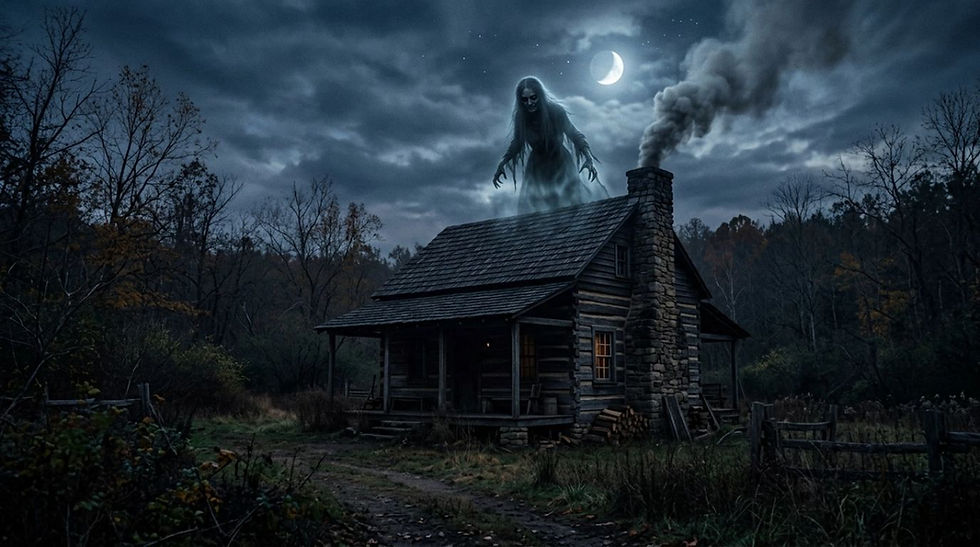
The Greenbrier Ghost: America's Most Chilling Murder Mystery
Updated: Sep 19
A few years ago, I was standing in an old courthouse archive room with a local historian who'd spent decades digging through forgotten case files. He pulled out a yellowed newspaper clipping. Slid it across the table, and said, "I've seen false confessions, missing evidence, and witness mistakes. But I've never seen another case quite like this." The headline mentioned a murder trial in rural West Virginia. And at the centre of it all was a ghost.
Now, if you spend enough time around paranormal research. You learn pretty quickly that ghost stories usually fall into one of two categories. You have the campfire tales that grow bigger with every retelling. And then you have the stories anchored to real documents, real people, and real court records. The Greenbrier Ghost sits in that strange overlap between the two.
The thing is, this isn't just a haunted folklore story. It's a genuine homicide case from 1897 involving a dead woman named Zona Heaster Shue. Her grieving mother Mary Jane Heaster, and a husband whose behaviour raised alarm bells long before anyone mentioned the supernatural. And that's why you should pay attention to it. Because you don't need to believe in ghosts to find this case deeply unsettling.
While researching this case, you can explore our complete database of phenomena over on our master Ghosts and Hauntings Archive.
True Crime Meets the Paranormal: Categorizing Spectral Jurisprudence
In the annals of American legal history, the trial of Erasmus Stribbling Trout Shue occupies a entirely unique sub-genre known as "Spectral Evidence." While famously associated with the Salem Witch Trials of 1692, the use of supernatural testimony had been completely eradicated from American courtrooms by the late 19th century. What makes the Greenbrier Ghost murder case a monumental anomaly is how a nineteenth-century court handled a homicide investigation where the primary catalyst for exhumation was an alleged message from beyond the grave.
A Mysterious Death in Greenbrier County
In January 1897, twenty-three-year-old Elva Zona Heaster Shue died suddenly at her home near Greenbrier County, West Virginia. Her death should have been straightforward. It wasn't. Zona had married Erasmus Stribbling Trout Shue. Usually called Edward Shue, just three months earlier. By all accounts, the relationship moved quickly. Too quickly, some neighbours thought.
On the day she died, Edward wasn't even home when her body was discovered. Instead, a young boy he'd sent on an errand found Zona lying motionless at the foot of the stairs. When Edward returned, witnesses later recalled that his reaction felt unusually theatrical. He carried her body upstairs, dressed her in her best clothes, and refused to leave her side.
I always tell people to be careful about judging grief. People react in strange ways to trauma. But you also can't ignore patterns. And Edward's behaviour created a lot of questions.

The Doctor Who Couldn't Finish His Examination
When Dr. George Knapp arrived, he found Edward cradling Zona's body. The new husband was reportedly hysterical. He wouldn't allow anyone near her. He insisted on handling her himself. Dr. Knapp later stated that he managed only a limited examination because Edward became increasingly agitated whenever he approached the body. What the doctor did notice was troubling.
There appeared to be discolouration around Zona's neck and face. At first, the official cause of death was listed as complications related to childbirth. Despite there being no clear evidence that pregnancy had anything to do with her death. Later, the cause was revised to everlasting faint. Honestly, even by nineteenth-century standards, that explanation feels vague. You can understand why people started whispering.
The Funeral That Raised More Questions
At the wake, Edward remained glued to the coffin. He positioned pillows around Zona's head. He wrapped a scarf around her neck. And he became visibly upset whenever anyone approached too closely. Makes sense if you're grieving, right? Maybe. But witnesses later recalled that he seemed especially determined to prevent anyone from examining her neck. That detail would become important. Very important.
Then something strange happened. Mary Jane Heaster removed a sheet from her daughter's coffin shortly before the burial. At first, she noticed only an unusual smell. Later, when she attempted to wash the sheet, the water reportedly turned red. When she poured some into another container. The liquid appeared clear again, yet the basin remained stained. The sheet itself changed colour permanently.
Now, let's be honest here. There are rational explanations for this. Dyes can bleed. Embalming chemicals can react unpredictably. Memory changes over time. But for a grieving mother already convinced something terrible had happened, this experience confirmed her worst fears.
Four Nights of Visitations
Mary Jane prayed for answers. Then, according to her testimony, she received them. For four consecutive nights, she claimed Zona's spirit appeared in her home. Her daughter allegedly described how Edward had become enraged because dinner wasn't prepared the way he wanted. The ghost claimed he attacked her. Strangled her. Broke her neck. To prove it, Mary Jane said the apparition turned its head completely around.
It's the sort of detail that sounds tailor-made for folklore. And maybe it is. But here's where the story becomes genuinely fascinating. Mary Jane didn't keep these experiences private. She went straight to the local prosecutor.

When a Prosecutor Listens to a Ghost Story
John Alfred Preston, the county prosecutor, faced an unusual situation. Officially, he couldn't act based on spectral testimony. Fair enough. No court in America accepts witness statements from the dead. But the thing is, Preston already had concerns about Edward's account of events.
The inconsistent medical findings. The husband's suspicious behaviour. The speed of the burial. The growing rumours throughout town. Mary Jane's story didn't launch the investigation by itself. It simply reinforced doubts that already existed.
That's an important distinction you should remember. Recently, people have simplified this case into a headline: "Ghost Solves Murder." Reality is messier than that. Preston ordered Zona's body exhumed. And that's when everything changed.
The Autopsy That Changed Everything
The post-mortem examination revealed exactly what Mary Jane had claimed. Zona's neck had been broken. Her windpipe was crushed. There were bruises consistent with strangulation. The first and second vertebrae had been dislocated. Suddenly, what had looked like an unexplained death became a homicide investigation.
Edward Shue was arrested immediately. And investigators soon discovered something deeply disturbing about his past.
Edward Shue's Troubling History
As authorities dug deeper, they uncovered evidence of previous marriages. One had ended in divorce. Another wife had died unexpectedly under suspicious circumstances. Neighbours described Edward as controlling and volatile. He reportedly boasted that he intended to have seven wives before settling down.
You know that feeling when separate pieces of information start fitting together like a jigsaw puzzle? That's what happened here. No single detail proved murder. But taken together. The rushed burial, the strange behaviour, the prior history, the autopsy findings. The picture became increasingly difficult to ignore.
It's a bit like following an EVP trail during a paranormal investigation. One anomaly means very little. Five or six anomalies pointing in the same direction? That's different.
The Pattern of Abuse: Allie Fry and Lucy Tritt
When Prosecutor John Alfred Preston began unravelling Edward Shue's past, he uncovered a terrifying pattern of serial domestic violence. Shue’s first marriage to a woman named Allie Estelline Fry had ended in divorce after she fled his volatile temper, detailing to local authorities that he had physically broken her bones. Shue's second marriage to Lucy Tritt ended in absolute tragedy when she died suddenly from what was ruled an accidental fall. Local whispers in her hometown later suggested her neck had been fractured under highly suspicious circumstances, mirroring the exact, grim injuries later discovered on Zona Heaster Shue.

The Trial of the Greenbrier Ghost
Edward entered the courtroom confident. No eyewitness had seen the crime. There was no confession. No murder weapon. His attorney believed the prosecution's case was weak. Then the defence made a serious mistake. Trying to undermine Mary Jane's credibility, Edward's lawyer invited her to repeat the ghost story in court.
I suspect he expected the jury to laugh. Instead, the opposite happened. Mary Jane remained calm. Consistent. Certain.
She explained exactly what Zona's spirit had told her. And when she described the broken neck and strangulation, jurors realised something unsettling. Those details matched the autopsy findings. Information that few people outside the investigation knew at the time.
The Strategic Blunder: Cross-Examining a Ghost Story
From a legal standpoint, the introduction of the ghost story was not a victory achieved by the prosecution. Prosecutor Preston, fully aware of the strict rules of evidence, deliberately avoided mentioning Mary Jane Heaster's spiritual visitations during his opening arguments, relying instead on solid forensic data from the autopsy. It was Shue's defense attorney, Dr. William Rucker, who made the catastrophic tactical blunder of bringing up the apparition. Rucker extensively cross-examined Mary Jane about her visions on the witness stand, hoping to portray her to the jury as a delusional, grief-stricken fanatic. Instead, her unshakable, highly consistent testimony bound the supernatural narrative permanently into the official trial record.
Did Mary Jane somehow guess correctly? Had she noticed signs others missed? Had rumours already spread through the community? Or did her daughter truly return from the dead? Who knows?
What we do know is that the jury found Edward guilty of murder. He was sentenced to life imprisonment. He died behind bars in 1900.
Did a Ghost Really Solve the Case?
Let's separate folklore from fact.
Verified historical facts:
Zona Heaster Shue died in January 1897.
Her initial cause of death was recorded incorrectly.
Her body was later exhumed.
The autopsy confirmed strangulation.
Edward Shue was convicted of murder.
Mary Jane publicly claimed that Zona's ghost revealed the truth.
Witness testimony:
Edward behaved strangely before and during the funeral.
Mary Jane experienced four alleged visitations.
Folklore:
Zona's spirit turned its head 360 degrees.
The blood-red water stained the funeral sheet permanently.
Speculation:
The ghost directly influenced the prosecutor's decision.
Sceptical Explanations Exist, Too
Mary Jane may have observed injuries at the funeral without consciously processing them. She may have overheard medical rumours. Grief can create vivid experiences that feel completely real. Memory changes over time. Stories grow. That's how legends work.
But here's the question I keep coming back to. Why did Edward's defence team choose to raise the ghost story at all? If they'd ignored it completely, we probably wouldn't be discussing this case more than a century later. Instead, they transformed a local murder trial into one of America's most enduring paranormal legends. And maybe that's why the Greenbrier Ghost still fascinates us.
Not because it proves life after death. Not because it proves ghosts can testify. But because it forces you to confront an uncomfortable possibility.
Tourism and the Legend: The Sam Black Church Landmark
Today, the legacy of Zona Heaster Shue has transitioned from old court archives into a major point of interest for West Virginia paranormal tourism. Travelers driving along US Route 60 near the Sam Black Church in Greenbrier County will encounter an official West Virginia State Historical Marker. Erected by the state’s Department of Archives and History, it stands proudly as the only state-sanctioned historical highway marker in the United States to explicitly commemorate a legal case solved by a ghost, keeping the memory of Zona's quest for justice alive for passing generations.
What if sometimes the dead aren't asking for revenge? What if they're asking for justice? So where do you land on this one? Do you think Mary Jane was guided by grief, intuition, and careful observation? Or did Zona Heaster Shue really return to identify her killer?
The Greenbrier Ghost Frequently Asked Questions
Was the Greenbrier Ghost story legally used as evidence in court?
Technically, the prosecution did not use the ghost story as legal evidence to convict Edward Shue. Knowing that spectral evidence was entirely inadmissible in a 1897 American courtroom, the prosecutor built his case solely on the physical autopsy report. It was actually the defense attorney who forced the ghost story into the trial record during cross-examination, intending to humiliate the victim's mother but inadvertently making her look incredibly credible to the jury.
What did the autopsy reveal about Zona Heaster Shue?
The exhumation and subsequent post-mortem examination conducted by Dr. George Knapp revealed that Zona Heaster Shue had been brutally murdered. The forensic findings confirmed that her neck had been broken, her windpipe was physically crushed, and her first and second cervical vertebrae had been completely dislocated, matching the exact physical description her mother claimed to receive from her spirit.
What happened to Edward Shue after the trial?
Following a brief trial in Greenbrier County, the jury found Erasmus Stribbling Trout Shue (Edward Shue) guilty of first-degree murder. He was spared the gallows but received a sentence of life imprisonment at the West Virginia State Penitentiary in Moundsville. Shue ultimately died behind bars in March 1900 during a localized disease outbreak.
How do skeptics explain the Greenbrier Ghost visions?
Skeptics and historical researchers explain Mary Jane Heaster's four nights of visitations through intense psychological grief and acute observation. It is highly probable that Mary Jane noticed the bruising, the protective scarf, and Edward's hyper-fixation on pinning down Zona's head during the open-casket wake. Her subconscious mind likely processed these suspicious physical clues into a vivid, waking grief-hallucination that allowed her to vocalize her suspicions to the local prosecutor.
Where can I visit the Greenbrier Ghost historical marker?
You can visit the official Greenbrier Ghost historical highway sign located along US Route 60 in Greenbrier County, West Virginia, situated near the Sam Black Church plaza. The marker is a highly popular destination for true-crime enthusiasts and road-trippers tracking famous Appalachian folklore sites.