
The Man Who Came Back From The Dead: A Chilling Bogotá Hospital Mystery
- May 10
- 4 min read
Imagine lying in a silent hospital ward, the air thick with finality. Machines stand still. Doctors step back. A life has ended, at least, that’s what everyone believes.
Then suddenly… movement.
This isn’t fiction. It’s a real event that reportedly took place in 2013, inside a hospital in Bogotá, and it continues to raise unsettling questions about the nature of death itself.
A Death Confirmed… Or So It Seemed
According to reports published by outlets such as the Metro and Daily Star, the incident involved a father of three who had suffered a fatal stab wound directly to the heart.
When he arrived at the hospital, the medical staff did everything possible to save him. Emergency procedures were carried out, and attempts were made to restart his heart.
But nothing worked.
Eventually, doctors were forced to make the call no one wants to make.
He was declared dead.
The room fell into a heavy silence, the kind that only follows the end of a life.
Forty-Five Minutes Later… The Impossible Happens
Time passed.
Minutes stretched into what must have felt like an eternity for the staff present. The man’s body remained motionless. There were no signs of life. No heartbeat. No breathing.
Then, something changed.
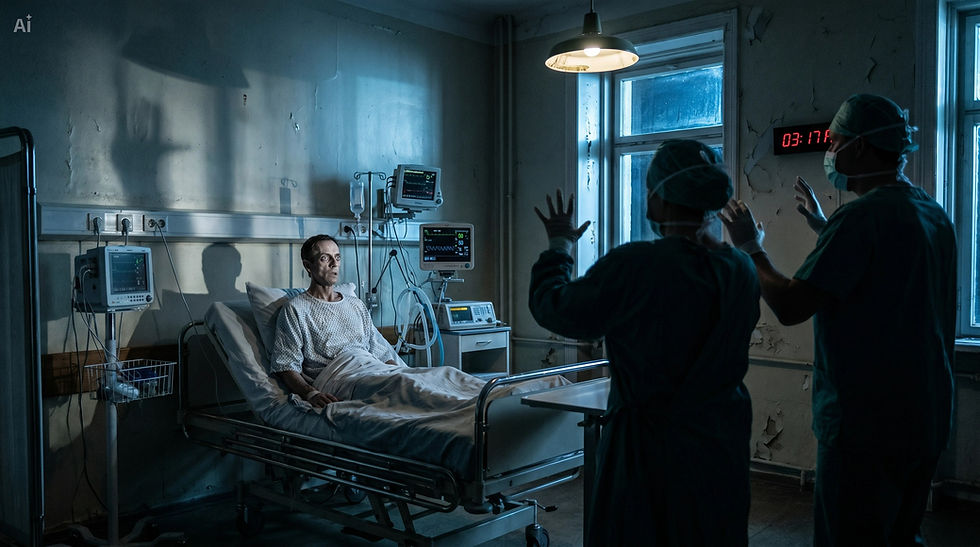
Approximately 45 minutes after being declared dead, the man’s body reportedly began to move.
At first, it may have seemed like a reflex. But then came the unmistakable signs, his chest rising, his eyes opening.
He was alive. He was back from the dead.
Shock in the Hospital Ward
The medical team, trained to deal with life-and-death situations, were left stunned.
Hospital director Juan Ernesto Oviedo reportedly described the event as beyond explanation:
“It’s indescribable… We are amazed by this case.”
For professionals grounded in science and procedure, this wasn’t just unusual, it was deeply unsettling.
Because, according to everything they knew, this shouldn’t have been possible.
Can Science Explain This?
While the story feels almost supernatural, there are a few medical phenomena that might offer possible explanations, though none fully account for every detail.
1. The Lazarus Phenomenon
One of the most commonly cited explanations is something known as the Lazarus phenomenon.
This rare condition occurs when a person’s heart restarts on its own after CPR has stopped.
It has been documented in medical literature
It can happen minutes after resuscitation efforts cease
The exact cause is still not fully understood
However, most recorded cases happen within a much shorter timeframe, often within 10 minutes, not 45.
That gap is what makes this case particularly strange.
2. Delayed Cardiac Activity
In some situations, pressure in the chest (caused by CPR or ventilation) can temporarily prevent the heart from restarting. Once that pressure is released, the heart may begin beating again.
But again, the length of time involved here stretches credibility within known medical limits.
3. Misdiagnosis of Death
It’s uncomfortable to consider, but historically, there have been rare cases where death was declared prematurely.
Modern medicine has strict protocols to prevent this, including:
Checking for electrical heart activity
Monitoring breathing
Observing neurological response
Still, in chaotic emergency situations, especially involving severe trauma, errors, however rare, are not impossible.

The Paranormal Question: Something More?
For those drawn to the unexplained, this case invites a far more unsettling question:
What if it wasn’t just medical?
Across cultures and centuries, stories have persisted of individuals who:
Were declared dead
Experienced something beyond
Returned… changed
Some interpretations suggest:
A near-death experience (NDE) interrupted midway
A spiritual “return” or unfinished purpose
Or even intervention by an unseen force
While there is no scientific evidence to support these ideas, they remain deeply rooted in human belief systems.
Near-Death Experiences: A Glimpse Beyond?
Cases like this often overlap with reports of near-death experiences, where individuals describe:
Moving through darkness or tunnels
Encountering light or entities
Feeling detached from their physical body
Researchers in neuroscience often attribute these experiences to:
Oxygen deprivation in the brain
Chemical reactions during trauma
The brain’s attempt to process imminent death
But here’s the problem:
This man was reportedly gone for 45 minutes.
That pushes the boundaries of what the brain should be able to recover from without severe, irreversible damage.
Why This Case Still Disturbs Experts
Even today, cases like this sit in an uncomfortable space between:
Medical anomaly
Human error
And something we simply don’t yet understand
What makes this incident particularly haunting is not just that the man survived, but how long he was believed to be dead.
It forces an unsettling possibility:
Do we truly understand the moment life ends?

A Thin Line Between Coming Back From The Dead
Hospitals are places of science, precision, and control. Yet every so often, something happens that reminds us how fragile, and mysterious, life really is.
In a quiet ward in Bogotá, a man crossed that invisible line… and came back.
Whether this was:
A rare medical event
A misjudgment
Or something far stranger
One thing is certain:
The boundary between life and death may not be as absolute as we believe.



Comments