
The Chatham House Assemblies: Inside the Architecture of Discreet Diplomacy
A polished gentleman in a tailored wool coat stepped out of a black cab into the thick, yellow fog of a London evening late in the autumn of 1920. He carried no official diplomatic pouch or state credentials. But instead slipped quietly through the heavy double doors of a grand town house on St. James's Square. When the heavy timber doors clicked shut behind him. He entered a room where the traditional constraints of public accountability vanished completely. Allowing political adversaries to sit by the fire and debate the future of global empires without a single word ever being traced back to their home governments.
This discreet urban gathering marked the physical genesis of the Chatham House assemblies. A series of highly influential meetings that effectively established the architecture of discreet diplomacy for the modern era. For generations, alternative researchers, alternative historians, and fringe political commentators have argued that this private London institute functions as an underground engine for a globalist deep state. Pulling the levers of geopolitical power completely behind closed doors. But did this organisation truly operate as a sinister shadow cabinet plotting the consolidation of corporate wealth. Or did the traumatic geopolitical fallout of the First World War simply force an elite circle of intellectuals to build a massive, highly theatrical playground to speak candidly away from the prying eyes of the press? Let's take a close look at the actual archival timeline and map this out chronologically. Because if you want to understand how modern international relations are engineered. You have to look at the ground-level construction of this quiet network.
While researching this case, you can explore our complete database over on our master Secret Societies Archive.
The Paris Peace Conference and the Lost Dream of Open Covenant
To trace the absolute origin of this mystery. We have to look closely at the chaotic diplomatic landscape of Europe during the spring of 1919. The world was still reeling from the unprecedented slaughter of the Great War, and the victorious allied powers gathered at the Paris Peace Conference to completely redraw the map of the world. American President Woodrow Wilson had arrived in Europe loudly championing his famous "Fourteen Points." Which explicitly called for "open covenants of peace, openly arrived at." Wilson genuinely believed that the old system of secret treaties, backroom imperial deals, and private aristocratic alliances had been the primary cause of the global cataclysm.
But the daily reality of the Paris negotiations quickly turned Wilson's beautiful idealistic dream into a complete farce. The representatives found that when they tried to debate high-stakes border disputes, war reparations, and colonial mandates in front of an aggressive international press corps. The politicians simply engaged in loud, nationalistic posturing for their home audiences. Progress ground to an absolute halt, and negotiations became like trying to settle a high-stakes corporate merger in the middle of a packed football stadium. The delegates grew completely exhausted by the constant media surveillance and the systematic leaks that threatened to collapse their fragile peace talks.
Realising the process was broken. A select circle of young British and American delegates began holding informal evening meetings at the Hotel Majestic in Paris to swap ideas. The core group included brilliant intellectuals like Lionel Curtis. A dedicated imperial administrator, and Whitney Shepardson, an influential American attorney. They basically realised that while total state secrecy led to dangerous military alliances. Total public exposure rendered serious geopolitical compromise completely impossible. They decided that the only way to successfully navigate the coming century was to create a permanent, non-governmental institutional network. Where the elite could bridge the gap between open democracies and private statecraft.
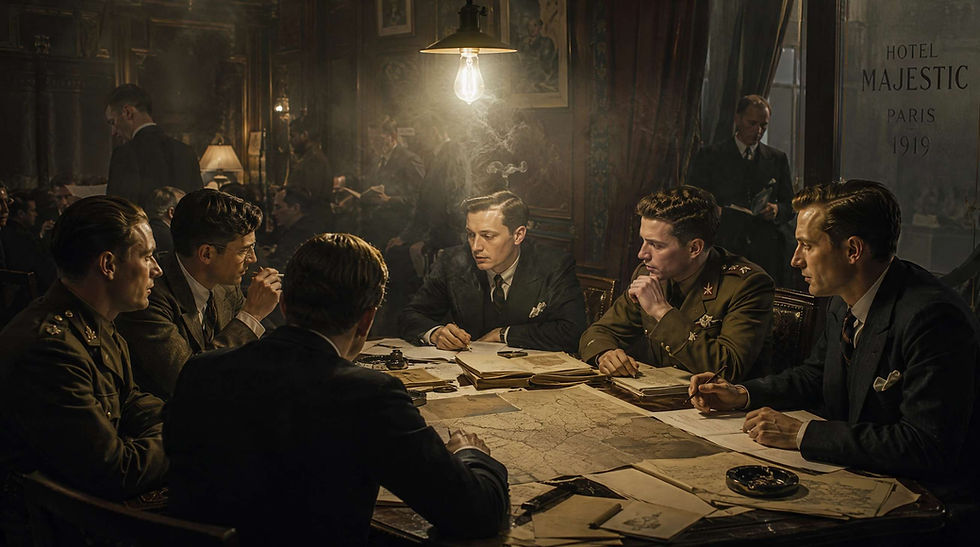
The Foundation of the Royal Institute of International Affairs
The informal Majestic discussions crystallised into a concrete organisational plan on May 30, 1919. When the British and American delegates held a grand joint meeting in Paris to formally establish an international institute of foreign affairs. The initial idea was to create a single, unified Anglo-American organisation that would coordinate the foreign policies of the two rising global powers. But when the delegates returned to their respective home countries. The political realities of American isolationism forced the group to split down the middle. Creating two separate but deeply intertwined sister organisations. The American branch eventually evolved into the Council on Foreign Relations (CFR) in New York. While the British contingent set up shop in London.
In 1920, the British branch officially launched its operations as the British Institute of International Affairs. By 1923, the fraternity secured a massive permanent upgrade when two wealthy Canadian benefactors, Colonel R.W. Leonard and his wife. Purchased a spectacular, historic town house at 10 St. James's Square and gifted it to the institute. The property was known universally as Chatham House. Having previously served as the private residence of three legendary British Prime Ministers, including William Pitt the Elder, the Earl of Chatham.
The organisers systematically transformed this grand building into an elite, highly structured research fortress. They built massive libraries, established specialised academic journals, and constructed private conference rooms. Designed to blend old-world aristocratic comfort with cutting-edge economic analysis. The group secured an immense boost in prestige in 1926 when King George V granted them a formal Royal Charter. Officially renaming the body the Royal Institute of International Affairs. The club's membership rolls began to look like a literal who's who of global authority. Packed with high-ranking diplomats, corporate oil barons, international bankers, and top-tier journalists who were sworn to maintain the ultimate boundary between the institute's walls and the outside world.
The 1927 Formulation of the Chatham House Rule
As the membership rolls filled up with highly volatile political factions during the late 1920s. The directors realised they needed a concrete, legally binding framework to protect their speakers from public scandals. The problem was that if a high-ranking German diplomat or a British treasury official spoke candidly about currency manipulation or colonial independence. A single leak in the morning newspapers could trigger a massive national panic or a literal declaration of war. To solve this operational security issue. The institute's inner circle officially formulated a strict code of conversational conduct in June 1927. Which would become legendary across global diplomatic circles as the Chatham House Rule.
The rule was beautifully simple but incredibly profound in its psychological conditioning. The original 1927 text established that when a meeting, or part thereof, is held under the Chatham House Rule. Participants are completely free to use the information received, but neither the identity nor the affiliation of the speakers, nor that of any other participant, may be revealed. (The rule underwent a minor, subtle stylistic update in 1992 and another clarification in 2002 to make it completely universal. But the core mechanism remained entirely untouched).
And this structured layout was an absolute masterpiece of counter-intelligence design. It didn't ban members from talking about the meetings. Instead, it systematically stripped away the names and organisations attached to the data. It created a unique, intermediate gray zone of information flow. A corporate baron could attend a late-night assembly at Chatham House. Listen to a senior intelligence director explain a looming collapse in Middle Eastern oil production. And walk straight back to his boardroom to alter his global investment strategy the next morning. But he was legally, fraternally forbidden from ever revealing who gave him the tip. Rendering the source completely invisible to public regulators or rival corporate entities.
The Interwar Nexus and the Toynbee Intelligence Grid
During the dark, tense decade of the 1930s. Chatham House completely outgrew its reputation as a simple academic think tank. Evolving into the absolute nerve center for the British foreign policy establishment. The institute's research direction fell under the total dominance of a brilliant, eccentric historian named Professor Arnold J. Toynbee. Toynbee was a massive intellectual polyglot who spent decades composing his monumental, twelve-volume A Study of History. Which mapped out the rise and catastrophic fall of human civilisations using a highly complex, cyclical alchemical framework.
Toynbee systematically transformed the research staff of Chatham House into a highly sophisticated, undercover intelligence grid for the British government. He used the institute's vast international connections to gather cutting-edge data on the economic vulnerabilities of Nazi Germany. The military expansion of Imperial Japan, and the shifting political alignments of the Soviet Union. When the Second World War finally exploded in September 1939. The entire operational infrastructure of Chatham House was instantly mobilised by the state.
The Foreign Office officially absorbed Toynbee's team. Transforming the institute's research department into the Foreign Research and Press Service (FRPS). A high-security wartime intelligence bureau based at Balliol College, Oxford. The scholars spent years analysing intercepted foreign media. Drafting top-secret geopolitical briefings for Winston Churchill's war cabinet. And quietly mapping out the post-war boundaries of Europe long before the battles were won. It was a massive intellectual insurgency. An undercover deep state being run by university professors and historians right under the cover of an educational charity.
The Post-War Reconstruction and the Anglo American Elite
When the war ground to an end in 1945. The leaders of Chatham House played a monumental, hidden role in organising the structural architecture of the post-war global economy. The institute hosted a series of highly exclusive, off-the-record conferences that brought together the top financial minds of the Western world. Helping to pave the way for the historic Bretton Woods agreements, the creation of the International Monetary Fund (IMF), and the early operational frameworks of the United Nations.
But this extreme concentration of unchecked international power quickly caught the attention of early anti-globalist researchers and populist politicians. By the mid-twentieth century. Critics began pointing out that Chatham House was operating as the European engine for what they termed the "Round Table" conspiracy. A highly secretive network originally envisioned by the imperial diamond magnate Cecil Rhodes to quietly unite the English-speaking nations into a single, omnipotent global empire. The institute became the ultimate target for fringe alternative folklore.
Traditional alternative researchers argued that the lower degrees of the institute's public lectures were just a clean, innocent front designed to trap ordinary journalists and academics. While the true, sinister political work was orchestrated entirely by an elite inner core of international bankers and corporate directors who used the Chatham House Rule to mask their wheeling-and-dealing. The institute reacted to this growing scrutiny with absolute, quiet disdain. Installing advanced security measures at 10 St. James's Square. Keeping their meeting transcripts strictly guarded, and utilising elite legal networks to protect the absolute anonymity of their high-level guests.
Skeptical Realities and the Material Archive Verdict
When you subject this entire history to cold, hard historical criticism. The grand illusion of an occult shadow empire completely breaks down into simple, well-documented institutional realities. The detailed forensic analysis of the institute's corporate archives, funding logs, and published papers proves conclusively that Chatham House is not a dark occult coven plotting the destruction of national sovereignty. It is basically an exceptionally high-end, highly prestigious elite social network and research center. That allows the ruling class to coordinate policy outside the volatile arena of public party politics. It is like trying to run an academic university department with an unlimited corporate networking budget.
The real danger of the Chatham House assemblies is not paranormal or demonic at all. It is entirely democratic. The rule of discreet diplomacy functions as a highly effective machine for class consolidation. An exclusive playground where the ultra-wealthy can build tight personal bonds that allow them to coordinate international trade policies, fix market priorities, and steer government strategies completely outside the legal frameworks of public oversight. By providing an unassailable sanctuary where public officials can speak off the record with defense contractors and international financiers. The institute effectively hollows out the democratic process. Ensuring that the most critical choices shaping our world are made by old friends gathering in quiet London rooms long before they are ever presented to a single voter.
The Chatham House Assemblies Frequently Asked Questions
What exactly is the Chatham House Rule?
It is a famous code of confidentiality formulated in 1927 which states that participants in a meeting are completely free to use the information they receive. But they are strictly forbidden from ever revealing the identity or affiliation of the speakers or any other participant.
Where is Chatham House located and what is its history?
It is located at 10 St. James's Square in London, England [NPA]. The historic town house previously served as the private residence of three British Prime Ministers before being gifted to the Royal Institute of International Affairs in the 1920s.
Is Chatham House a secret society?
No, it is a registered independent think tank and educational charity that publishes extensive public reports, hosts open lectures, and runs academic journals. Though its high-level diplomatic assemblies are protected by strict rules of confidentiality.
What was the connection between Chatham House and British intelligence in WW2?
During the war, the institute's entire research department was officially absorbed by the Foreign Office to run the Foreign Research and Press Service. Providing top-secret geopolitical briefings and press analysis for the war cabinet.
How did the Paris Peace Conference of 1919 lead to the creation of the institute?
The founders grew completely frustrated by how public media surveillance and political posturing disrupted the high-stakes peace talks. Prompting them to create a private institutional network where the elite could speak candidly away from the press.
Who can attend the private assemblies at Chatham House today?
Attendance is strictly restricted to invited members, senior corporate executives, foreign diplomats, government officials, and select academic experts who pass rigorous institutional security clearances.
Sources and Further Reading
Carrington, Charles. Chatham House: A Brief Account of the Origins and History of the Royal Institute of International Affairs. Oxford University Press, 1950.
Toynbee, Arnold J. Acquaintances. Oxford University Press, 1967. (Provides authentic inside details on the interwar research grid).
Quigley, Carroll. The Anglo-American Establishment: From Rhodes to Cliveden. Books in Focus, 1981. (The foundational text for the alternative Round Table historical theories).
King, Francis. Modern Ritual Magic: The Rise of Western Occultism. Prism Press, 1989. (Used for comparative analysis of elite twentieth-century fraternal operational structures).
Royal Institute of International Affairs. The Original 1927 Minutes and Charters Collection, Chatham House Archive, London.


